
|
You entered: rings
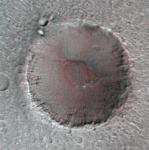 Mars: Big Crater in Stereo
30.04.1998
Get out your red/blue glasses and check out this stereo picture of "Big Crater" on Mars! (Pieces of red and blue or green clear plastic will do. Your right eye should look through...
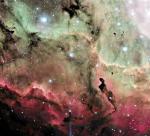 Close Up of the Lagoon Nebula
16.08.2004
Stars are battling gas and dust in the Lagoon Nebula but the photographers are winning. Also known as M8, this photogenic nebula is visible even without binoculars towards the constellation of Sagittarius. The energetic processes of star formation create not only the colors but the chaos.
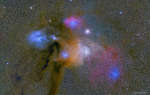 Colorful Clouds Near Rho Ophiuchi
5.07.2015
Why is the sky near Antares and Rho Ophiuchi so colorful? The colors result from a mixture of objects and processes. Fine dust illuminated from the front by starlight produces blue reflection nebulae. Gaseous clouds whose atoms are excited by ultraviolet starlight produce reddish emission nebulae. Backlit dust clouds block starlight and so appear dark.
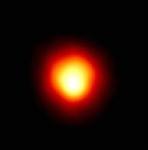 Betelgeuse, Betelgeuse, Betelgeuse
15.02.1997
Betelgeuse (sounds a lot like "beetle juice"), a red supergiant star about 600 light years distant, is seen in this Hubble Space Telescope image -- the first direct picture of the surface of a star other than the Sun. A bright, as yet unexplained hotspot is revealed on its surface!
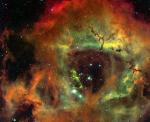 The Rosette Nebula in Hydrogen, Oxygen, and Sulfur
10.01.2000
The Rosette Nebula is a large emission nebula located 3000 light-years away. The great abundance of hydrogen gas gives NGC 2237 its red color in most photographs. The wind from the open cluster of stars known as NGC 2244 has cleared a hole in the nebula's center.
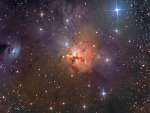 NGC 1579: Trifid of the North
29.01.2009
Colorful NGC 1579 resembles the better known Trifid Nebula, but lies much farther north in planet Earth's sky, in the heroic constellation Perseus. About 2,100 light-years away and 3 light-years across...
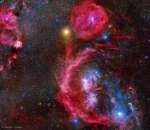 A 212 Hour Exposure of Orion
22.11.2015
The constellation of Orion is much more than three stars in a row. It is a direction in space that is rich with impressive nebulas. To better appreciate this well-known swath of sky, an extremely long exposure was taken over many clear nights in 2013 and 2014.
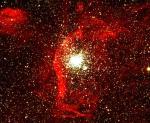 NGC 1850: Gas Clouds and Star Clusters
29.03.1999
There's nothing like it in our own Galaxy. Globular clusters as young as NGC 1850 don't exist here. Globular clusters only 40 millions of years old can still be found in the neighboring LMC galaxy, though, but perhaps none so unusual as NGC 1850.
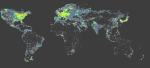 Artificial Night Sky Brightness
27.08.2001
Where have all the dim stars gone? From many places on the Earth including major cities, the night sky has been reduced from a fascinating display of hundreds of stars to a diffuse glow through which only a handful of stars are visible.
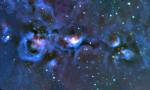 NGC 6334: The Bear Claw Nebula
6.04.1999
NGC 6334 is a cloud of gas and dust that appears to be forming massive stars. At 5500 light-years away, the Bear Claw Nebula, as it has also been dubbed, is more than three times as distant as the Orion Nebula, but still close enough for detailed study.
|
January February March April May |
|||||||||||||||||||||||||||||||||||||||||||||||||