
|
You entered: rings
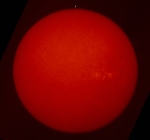 The Sun Today
18.05.1996
Our Sun shows a different face every day. The above picture was taken on May 15, but a similar picture of the Sun actually taken today can be found here. The above picture was taken in red light and so is shown in red.
 Light from the Heart Nebula
3.10.2006
What powers the Heart Nebula? The large emission nebula dubbed IC 1805 looks, in whole, like a human heart. The nebula glows brightly in red light emitted by its most prominent element: hydrogen. The red glow and the larger shape are all created by a small group of stars near the nebula's center.
 Yellow Balls in W33
30.01.2015
Infrared wavelengths of 3.6, 8.0, and 24.0 microns observed by the Spitzer Space Telescope are mapped into visible colors red, green, and blue in this striking image. The cosmic cloud of gas and dust is W33, a massive starforming complex some 13,000 light-years distant, near the plane of our Milky Way Galaxy.
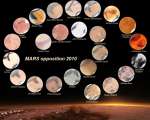 The Faces of Mars
5.05.2010
Enthusiastic astro-artists ranging from expert to beginner, the youngest age 10, all contributed their work to this entertaining panel featuring different faces of Mars. Their sketches are all based on telescopic views of the Red Planet from earlier this year, near its 2010 opposition.
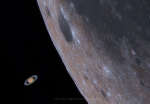 Moon Occults Saturn
9.04.2019
Sometimes Saturn disappears. It doesn't really go away, though, it just disappears from view when our Moon moves in front. Such a Saturnian eclipse was visible along a small swath of Earth -- from Brazil to Sri Lanka -- near the end of last month.
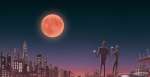 Tonight: A Supermoon Lunar Eclipse
27.09.2015
Tonight a bright full Moon will fade to red. Tonight's moon will be particularly bright because it is reaching its fully lit phase when it is relatively close to the Earth in its elliptical orbit.
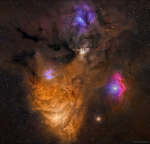 Dark Dust and Colorful Clouds near Antares
27.08.2019
Why is the sky near Antares and Rho Ophiuchi so dusty yet colorful? The colors result from a mixture of objects and processes. Fine dust illuminated from the front by starlight produces blue reflection nebulae. Gaseous clouds whose atoms are excited by ultraviolet starlight produce reddish emission nebulae.
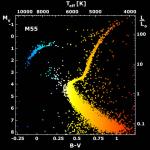 M55 Color Magnitude Diagram
23.02.2001
This color "picture" of globular star cluster M55 may not look like any star cluster you've ever seen. Still, it shows a most fundamental view for students of stellar astronomy. In the picture...
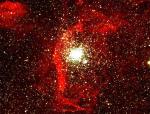 NGC 1850: Gas Clouds and Star Clusters
24.12.2000
There's nothing like it in our own Galaxy. Globular clusters as young as NGC 1850 don't exist here. Globular clusters only 40 millions of years old can still be found in the neighboring LMC galaxy, though, but perhaps none so unusual as NGC 1850.
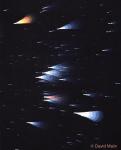 Orion's Star Colors
2.12.1996
What determines a star's color? Its temperature. Red stars are cool, with temperatures of around 3,000 degrees Kelvin (K), while blue stars are hotter and can have temperatures over 30,000 degrees K. Our own lovely yellow Sun's temperature is a comforting 6,000 degrees K.
|
January February March April May |
|||||||||||||||||||||||||||||||||||||||||||||||||