
|
You entered: rings
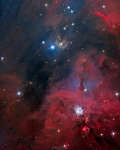 South of Orion
27.01.2022
South of the large star-forming region known as the Orion Nebula, lies bright blue reflection nebula NGC 1999. At the edge of the Orion molecular cloud complex some 1,500 light-years distant, NGC 1999's illumination is provided by the embedded variable star V380 Orionis.
 Earendel: A Star in the Early Universe
6.04.2022
Is Earendel the farthest star yet discovered? This scientific possibility started when the Hubble Space Telescope observed a huge cluster of galaxies. The gravitational lens effectбof this cluster was seen to magnify and distort a galaxy far in the background.
 Mars in the Loop
30.05.2025
This composite of images spaced a weather-permitting 5 to 9 days apart, from 2024 September 19 (top right) through 2025 May 18 (bottom left), faithfully traces ruddy-colored Mars as it makes a clockwise loop through the constellations Gemini and Cancer in planet Earth's night sky.
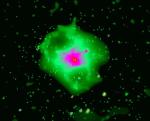 X rays From HCG 62
9.03.2001
Scanning the skies for galaxies Canadian astronomer Paul Hickson and colleagues identified some 100 compact groups of galaxies, now appropriately called Hickson Compact Groups (HCGs). With only a few member galaxies per group, HCGs...
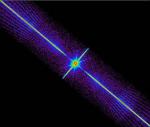 X Ray Rainbows
11.05.2001
A drop of water or prism of glass can spread out visible sunlight into a rainbow of colors. In order of increasing energy, the well known spectrum of colors in a rainbow runs red, orange, yellow, green, blue, indigo, violet.
 X Ray Rainbows
28.09.2002
A drop of water or prism of glass can spread out visible sunlight into a rainbow of colors. In order of increasing energy, the well known spectrum of colors in a rainbow runs red, orange, yellow, green, blue, indigo, violet.
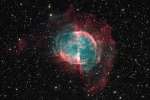 M27: Not a Comet
26.08.2010
While hunting for comets in the skies above 18th century France, astronomer Charles Messier diligently kept a list of the things he encountered that were definitely not comets. This is number 27 on his now famous not-a-comet list.
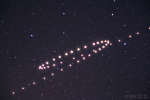 Mars in the Loop
9.08.2012
This composite of images spaced some 5 to 7 days apart from late October 2011 (top right) through early July 2012 (bottom left), traces the retrograde motion of ruddy-colored Mars through planet Earth's night sky.
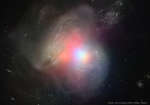 Arp 299: Black Holes in Colliding Galaxies
1.11.2016
Is only one black hole spewing high energy radiation -- or two? To help find out, astronomers trained NASA's Earth-orbiting NuSTAR and Chandra telescopes on Arp 299, the enigmatic colliding galaxies expelling the radiation.
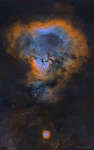 NGC 7822: Cosmic Question Mark
13.10.2021
It may look like a huge cosmic question mark, but the big question really is how does the bright gas and dark dust tell this nebula's history of star formation. At the edge...
|
January February March April May June July August September |
|||||||||||||||||||||||||||||||||||||||||||||||||