
|
You entered: rings
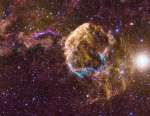 Sibling Supernova Remnants
2.07.2026
What happens when one of the stars in a binary goes supernova? This image combines visible (yellow), ultraviolet (purple) and infrared light (cyan, red and orange) to show two supernova remnants and their surrounding environment, about 6,000 light-years away. The younger one is the well-known Jellyfish Nebula in the center (mostly in yellow).
 EUVE Sky Map
31.01.2002
The stars beyond the Sun and the distant galaxies should be undetectable at extreme ultraviolet wavelengths. At least that was the conventional wisdom when it was first realized that the space between the stars is filled with hydrogen, a strong absorber of extreme ultraviolet light.
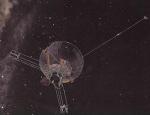 Pioneer 10: The First 6 Billion Miles
3.03.1997
Q: What was made by humans and is 6 billion miles away? A: Pioneer 10 - and yesterday was the 25th anniversary of its launch. More than 9 light hours distant, Pioneer 10 is presently about twice as far from the Sun as Pluto, bound for interstellar space at 28,000 miles per hour.
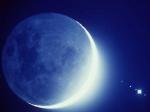 Tonight: A Blue Moon
31.07.2004
How often does a full moon occur twice in a single month? Exactly once in a Blue Moon. In fact, the modern usage of the term "Blue Moon" refers to the second Full Moon in a single month. Tonight's Blue Moon will be the first since November 2001.
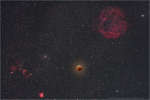 A Lunar Eclipse on Solstice Day
20.12.2010
Sometime after sunset tonight, the Moon will go dark. This total lunar eclipse, where the entire Moon is engulfed in the shadow of the Earth, will be visible from all of North America, while the partial phase of this eclipse will be visible throughout much of the rest of the world.
 Pickering s Triangle in the Veil
17.09.2015
Chaotic in appearance, these filaments of shocked, glowing gas break across planet Earth's sky toward the constellation of Cygnus, as part of the Veil Nebula. The Veil Nebula itself is a large supernova remnant, an expanding cloud born of the death explosion of a massive star.
 Williamina Fleming s Triangular Wisp
10.11.2017
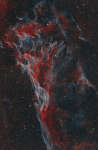
Chaotic in appearance, these tangled filaments of shocked, glowing gas are spread across planet Earth's sky toward the constellation of Cygnus as part of the Veil Nebula. The Veil Nebula itself is a large supernova remnant, an expanding cloud born of the death explosion of a massive star.
 The Hubble Ultra Deep Field in Light and Sound
5.03.2018
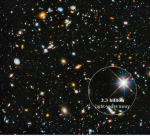
Have you heard about the Hubble Ultra-Deep Field? Either way, you've likely not heard about it like this -- please run your pointer over the featured image and listen! The Hubble Ultra-Deep Field (HUDF)...
 APOD: 2025 June 21 Б Two Worlds, Two Analemmas
21.06.2025
Sure, that figure-8 shaped curve you get when you mark the position of the Sun in Earth's sky at the same time each day over one year is called an analemma.
 The South Pole of Mars
13.12.2001
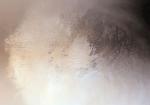
The south pole of Mars is the bright area near the center of the detailed, subtly shaded color image above. Recorded in September of this year by the Mars Global Surveyor (MGS) spacecraft, the picture shows a region surrounding the 400 kilometer wide martian polar cap in the midst of southern hemisphere spring.
|
January February March April May June July August |
||||||||||||||||||||||||||||||||||||||||||||||||||||||||