
|
You entered: rings
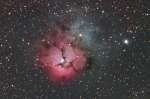 A Beautiful Trifid
30.05.2009
The beautiful Trifid Nebula is a colorful study in cosmic contrasts. Also known as M20, it lies about 5,000 light-years away toward the nebula rich constellation Sagittarius. A star forming region...
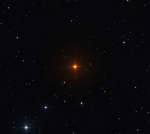 R Leporis: A Vampire's Star
31.10.2018
Better known as Hind's Crimson Star, R Leporis is a rare star in planet Earth's night sky. It's also a shocking shade of red. The star's discoverer, 19th century English...
 APOD: 2024 April 15 Б The Cigar Galaxy from Hubble and Webb
15.04.2024
Something strange happened to this galaxy, but what? Known as the Cigar Galaxy and cataloged as M82, red glowing gas and dust are being cast out from the center. Although this starburst galaxy...
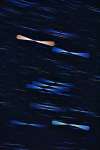 Star Colors in Orion
11.02.2011
What determines a star's color? Its temperature. Red stars are cool, with surface temperatures of around 3,000 kelvins (K), while blue stars are hotter and can have temperatures over 30,000 K. Our own lovely "yellow" Sun's temperature is a comforting 6,000 K.
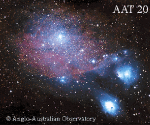 Nebulosity in Sagittarius
10.08.1997
What causes the colors in this beautiful nebulosity in Sagittarius? Dubbed NGC 6589 and NGC 6590, the colors of this nebulosity, are caused by gas and dust. The blue color of the nebula nearest the bright stars is caused by reflection off interstellar dust.
 A Colorful Aurora
1.09.1998
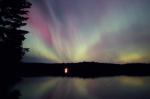
A solar storm overtook the Earth on August 26th. The Earth survived unscathed, as usual, although many northerners reported an impressive display of aurora. Many of these auroras changed rapidly, with patterns appearing and disappearing sometimes in less than a second. Out away from city lights, observers also reported an unusually spectacular array of colors.
 The Cat's Paw Nebula
7.12.1999
As soon as we find out whose cat did this . . . Nebulae are as famous for being identified with familiar shapes as perhaps cats are for getting into trouble. No cat, though, could have created the vast Cat's Paw Nebula visible in Scorpius.
 The Exploration of Mars
16.07.1995
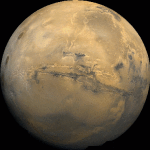
Thirty years ago NASA's exploration of Mars began. In July of 1965 the Mariner 4 spacecraft flew within 6,000 miles of Mars and returned 21 pictures of the mysterious red planet. NASA...
 Nebula Nova Cygni Turns On
25.08.2002
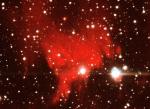
Old photographs show no evidence of the above nebula. In 1992, a white dwarf star toward the constellation of Cygnus blew off its outer layers in a classical nova explosion: an event called Nova Cygni 1992.
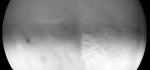 A Global Dust Storm on Mars
1.10.2001
A dust storm on Mars can involve nearly the entire planet. As spring descended on the southern hemisphere of the red planet this June and July, a global dust storm raged. Pictured above is the storm on July 8 as it spread up from the south, oriented on the lower right.
|
January February March April May |
|||||||||||||||||||||||||||||||||||||||||||||||||