
|
You entered: Sun
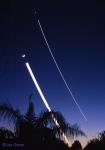 Venus Falls Out of the Evening Sky
3.09.1999
Orbiting closer to the Sun than planet Earth, bright Venus always appears to be near the Sun's position in our sky and often shines near the horizon in twilight hours. In fact, after...
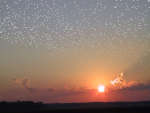 A Flock of Stars
6.09.2008
Only a few stars can be found within ten light-years of our lonely Sun, situated near an outer spiral arm of the Milky Way galaxy. But if the Sun were found within one of our galaxy's star clusters, thousands of stars might occupy a similar space.
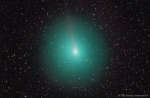 Comet 45P Passes Near the Earth
11.02.2017
A large snowball has just passed the Earth. Known as Comet 45P/HondaMrkosPajduАkovА", or 45P for short, the comet came 10 times closer to Earth yesterday than the Earth ever gets to the Sun. During this passage, the comet was photographed sporting a thin ion tail and a faint but expansive green coma.
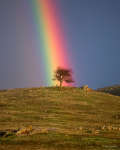 APOD: 2023 March 13 Б Rainbow Tree
12.03.2023
What lies at the end of a rainbow? Something different for everyone. For the photographer taking this picture, for example, one end of the rainbow ended at a tree. Others nearby, though, would likely see the rainbow end somewhere else. The reason is because a rainbow's position depends on the observer.
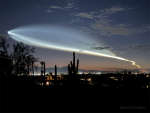 APOD: 2025 October 15 Б Rocket Launch Plume over Tucson
14.10.2025
Yes, but can your sunset do this? Looking west from Tucson, Arizona, USA one day last month, the sunset sky looked strange when it briefly lit up with the plume of a rocket launched from California a few minutes earlier.
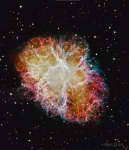 APOD: 2025 December 29 Б M1: The Crab Nebula
28.12.2025
This is the mess that is left when a star explodes. The Crab Nebula, the result of a supernova seen in 1054 AD, is filled with mysterious filaments. The filaments are not only tremendously...
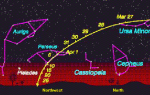 Comet Hyakutake Finder Chart for Early April
30.03.1996
During April Comet Hyakutake heads in toward the Sun after passing the Earth. At this time the comet's orbit places it north of the Earth. Remaining visible in the northern sky as it nears the Sun, it will set progressively earlier in the evening.
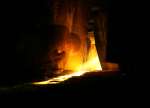 Solstice at Newgrange
19.12.2008
Tomorrow's solstice marks the southernmost point of the Sun's annual motion through planet Earth's sky and the astronomical beginning of winter in the north. In celebration of the northern winter solstice...
 Saturn at Equinox
21.09.2014
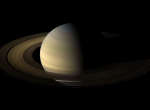
How would Saturn look if its ring plane pointed right at the Sun? Before August 2009, nobody knew. Every 15 years, as seen from Earth, Saturn's rings point toward the Earth and appear to disappear.
 Moon, Mercury, Monaco
17.03.2005
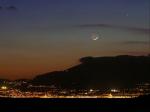
Low on the western horizon after sunset, a slender crescent Moon and wandering planet Mercury join the lights of Menton and Monaco along the French Riviera. Astronomer Vincent Jacques took advantage of this gorgeous...
|
January February March April May June July August September |
|||||||||||||||||||||||||||||||||||||||||||||||||