
|
You entered: Sun
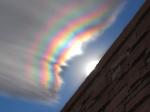 An Iridescent Cloud Over Colorado
25.11.2007
Why would a cloud appear to be different colors? A relatively rare phenomenon known as iridescent clouds can show unusual colors vividly or a whole spectrum of colors simultaneously. These clouds are formed of small water droplets of nearly uniform size.
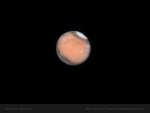 Mars Opposition 2010
29.01.2010
Mars is at opposition tonight, opposite the Sun in planet Earth's sky. Of course, it will be easy to spot because Mars appears close to tonight's Full Moon, also opposite the Sun in Earth's night sky in the constellation Cancer.
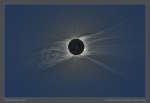 Total Solar Eclipse 2020
7.01.2021
Along a narrow path crossing southern South America through Chile and Argentina, the final New Moon of 2020 moved in front of the Sun on December 14 in the year's only total solar eclipse.
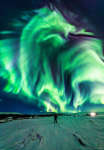 Dragon Aurora over Iceland
18.02.2019
Have you ever seen a dragon in the sky? Although real flying dragons don't exist, a huge dragon-shaped aurora developed in the sky over Iceland earlier this month. The aurora was caused...
 Pleiades, Planets, And Hot Plasma
24.05.2000
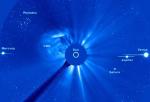
Bright stars of the Pleiades, four planets, and erupting solar plasma are all captured in this spectacular image from the space-based SOlar and Heliospheric Observatory (SOHO). In the foreground of the 15 degree wide field of view, a bubble of hot plasma, called a Coronal Mass Ejection (CME)
 APOD: 2023 September 17 Б Moon Mountains Magnified during Ring of Fire Eclipse
17.09.2023
What are those dark streaks in this composite image of a solar eclipse? They are reversed shadows of mountains at the edge of the Moon. The center image, captured from Xiamen, China, has the Moon's center directly in front of the Sun's center.
 Welcome to Planet Earth
4.02.2001
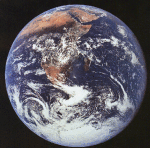
Welcome to Planet Earth, the third planet from a star named the Sun. The Earth is shaped like a sphere and composed mostly of rock. Over 70 percent of the Earth's surface is water. The planet has a relatively thin atmosphere composed mostly of nitrogen and oxygen.
 Heaven on Earth
23.02.2004
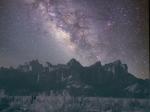
If sometimes it appears that the entire Milky Way Galaxy is raining down on your head, do not despair. It happens twice a day. As the Sun rises in the East, wonders of the night sky become less bright than the sunlight scattered by our own Earth's atmosphere, and so fade from view.
 A Lunar Corona over Turin
16.09.2019
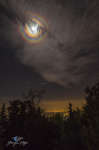
What are those colorful rings around the Moon? A corona. Rings like this will sometimes appear when the Moon is seen through thin clouds. The effect is created by the quantum mechanical diffraction of light around individual, similarly-sized water droplets in an intervening but mostly-transparent cloud.
 Comet 13P Olbers
28.06.2024
Not a paradox, Comet 13P/Olbers is returning to the inner Solar System after 68 years. The periodic, Halley-type comet will reach its next perihelion or closest approach to the Sun on June 30 and has become a target for binocular viewing low in planet Earth's northern hemisphere night skies.
|
January February March April May June July August September |
|||||||||||||||||||||||||||||||||||||||||||||||||