
|
You entered: Sun
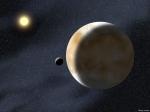 UB313: Larger than Pluto
7.02.2006
What do you call an outer Solar System object that is larger than Pluto? Nobody is yet sure. The question arose recently when 2003 UB313, an object currently twice as far out as Pluto and not in the plane with the rest of the planets, was verified recently to be 30 percent wider than Pluto.
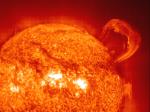 A Solar Prominence from SOHO
16.04.2006
How can gas float above the Sun? Twisted magnetic fields arching from the solar surface can trap ionized gas, suspending it in huge looping structures. These majestic plasma arches are seen as prominences above the solar limb.
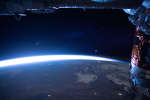 Comet NEOWISE from the ISS
10.07.2020
Rounding the Sun on July 3rd and currently headed for the outer Solar System, Comet NEOWISE (C/2020 F3) has been growing brighter in the predawn skies of planet Earth. From low Earth orbit...
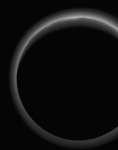 APOD: 2025 October 2 Б Pluto at Night
2.10.2025
The night side of Pluto spans this shadowy scene. In the stunning spacebased perspective, the Sun is 4.9 billion kilometers (almost 4.5 light-hours) behind the dim and distant world. It was captured by far flung New Horizons in July of 2015 when the spacecraft was at a range of some 21,000 kilometers from Pluto.
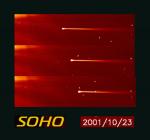 SOHO Comet 367: Sungrazer
9.11.2001
The most prolific comet discovering instrument in history rides aboard the sun-staring SOHO spacecraft, 1.5 million kilometers sunward of planet Earth. Of course, most of these SOHO comets have been sungrazers - like the one illustrated in the dramatic montage above.
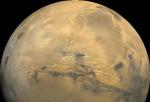 Mars: Just The Facts
27.06.1997
Mars, the freeze-dried planet, orbits 137 million miles from the Sun or at about 1.5 times the Earth-Sun distance. It has two diminutive moons, towering extinct volcanos, an immense canyon system, a thin atmosphere...
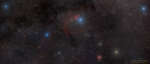 The W in Cassiopeia
18.03.2016
A familiar, zigzag, W pattern in northern constellation Cassiopeia is traced by five bright stars in this colorful and broad mosaic. Stretching about 15 degrees across rich starfields, the celestial scene includes dark clouds, bright nebulae, and star clusters along the Milky Way. In yellow-orange hues Cassiopeia's alpha star Shedar is a standout though.
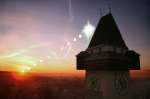 Sunrise, Moonrise
6.01.2011
For many Europeans, the Sun and New Moon rose together on January 4 in a partial solar eclipse. Arriving close on the heels of the new year, it was the first of a series of four(!) partial solar eclipses due in 2011.
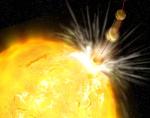 HD 82943: Planet Swallower
18.05.2001
Stars like HD 82943 are main sequence G dwarf stars with temperatures and compositions similar to the Sun. Also like the Sun, HD 82943 is known to have at least two giant planets, but unlike gas giants in our solar system their orbits are not nearly circular and bring them closer to the parent star.
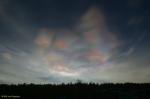 Iridescent clouds
11.03.2003
Why would clouds appear to be different colors? A relatively rare phenomenon known as iridescent clouds can show unusual colors vividly or a whole spectrum of colors simultaneously. These clouds are formed of small water droplets of nearly uniform size.
|
January February March April May June July August |
||||||||||||||||||||||||||||||||||||||||||||||||||||||||