
|
You entered: Sun
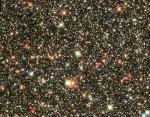 Sagittarius Star Cloud
20.05.2001
Stars come in all different colors. The color of a star indicates its surface temperature, an important property used to assign each star a spectral type. Most stars in the above Sagittarius Star Cloud are orange or red and relatively faint, as our Sun would appear.
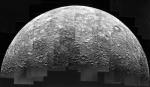 Mercury: A Cratered Inferno
19.08.2001
Mercury's surface looks similar to our Moon's. Each is heavily cratered and made of rock. Mercury's diameter is about 4800 km, while the Moon's is slightly less at about 3500 km (compared with about 12,700 km for the Earth). But Mercury is unique in many ways.
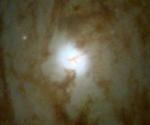 M51: The Center Of The Whirlpool
27.05.2000
In the center of M51, a spiral galaxy 23 million light-years away, astronomers have identified a dense region of young stars. Viewed face-on in the constellation Canes Venatici, the swirling arcs of this galaxy's spiral arms have inspired its popular name, The Whirlpool Galaxy.
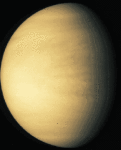 Venus: Earth's Sister Planet
15.08.1995
This picture in visible light was taken by the Galileo spacecraft. Venus is very similar to Earth in size and mass - and so is sometimes referred to as Earth's sister planet - but Venus has a quite different climate.
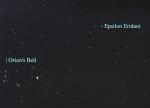 Nearby Star Epsilon Eridani Has a Planet
7.08.2000
A planet has been found orbiting a Sun-like star only 10 light-years away. No direct picture of the planet was taken - the planet was discovered by the gravitational wobble it created on its parent star, Epsilon Eridani. The discovery marks the closest Sun-like star yet found to house an extra-solar planet.
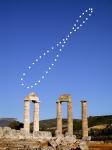 Analemma Over Ancient Nemea
21.06.2004
An anelemma is that figure-8 curve that you get when you mark the position of the Sun at the same time each day throughout planet Earth's year. Above, 44 separate exposures (plus...
 Flying Over Asteroid Eros
27.03.2000
What would it look like to fly over an asteroid? Spacecraft NEAR Shoemaker in orbit around asteroid 433 Eros found out earlier this month when it recorded its first fly-over sequence. The saddle region of the Sun-orbiting space-mountain appears to zip past the camera in this condensed hour-long time-lapse sequence.
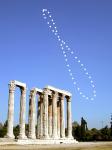 The Analemma and the Temple of Olympian Zeus
23.12.2006
An analemma is that figure-8 curve you get when you mark the position of the Sun at the same time each day throughout planet Earth's year. Above, 47 separate exposures (plus one foreground...
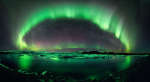 A Starry Night of Iceland
17.05.2011
On some nights, the sky is the best show in town. On this night, the sky was not only the best show in town, but a composite image of the sky won an international competition for landscape astrophotography. The above winning image was taken two months ago over JЖkulsАrlСn, the largest glacial lake in Iceland.
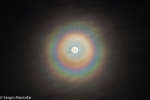 A Colorful Lunar Corona
15.06.2015
What are those colorful rings around the Moon? A corona. Rings like this will sometimes appear when the Moon is seen through thin clouds. The effect is created by the quantum mechanical diffraction of light around individual, similarly-sized water droplets in an intervening but mostly-transparent cloud.
|
January February March April May June July August September |
|||||||||||||||||||||||||||||||||||||||||||||||||