
|
You entered: universe
 APOD is 25 Years Old Today
16.06.2020
Welcome to the quadranscentennial year of the Astronomy Picture of the Day. Perhaps a source of consistency for some, APOD is still here. To help celebrate APOD's Silver Anniversary, some of APOD's TVAoTaSMD have recorded a birthday greeting and thanks to APOD's readership in today's featured video.
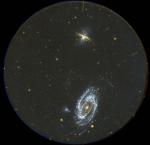 M81 and M82: GALEX Full Field
30.12.2004
Intriguing galaxy pair M81 and M82 shine in this full-field view from the orbiting GALEX observatory. GALEX - the Galaxy Evolution Explorer - scans the cosmos in ultraviolet light, a view that follows star formation and galaxy evolution through the Universe.
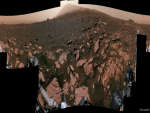 Ancient Ogunquit Beach on Mars
8.05.2017
This was once a beach -- on ancient Mars. The featured 360-degree panorama, horizontally compressed, was taken by the robotic Curiosity rover currently exploring the red planet. Named Ogunquit Beach after its terrestrial counterpart, evidence...
 APOD: 2023 July 18 Б Milky Way above La Palma Observatory
18.07.2023
What's happening in the night sky? To help find out, telescopes all over the globe will be pointing into deep space. Investigations will include trying to understand the early universe, finding and tracking Earth-menacing asteroids, searching for planets that might contain extra-terrestrial life, and monitoring stars to help better understand our Sun.
 APOD: 2024 October 1 Б Porphyrion: The Longest Known Black Hole Jets
1.10.2024
How far can black hole jets extend? A new record was found just recently with the discovery of a 23-million light-year long jet pair from a black hole active billions of years ago. Dubbed...
 APOD: 2024 October 2 Б The Large Magellanic Cloud Galaxy
2.10.2024
It is the largest satellite galaxy of our home Milky Way Galaxy. If you live in the south, the Large Magellanic Cloud (LMC) is quite noticeable, spanning about 10 degrees across the night sky, which is 20 times larger than the full moon towards the southern constellation of the dolphinfish (Dorado).
 APOD: 2024 December 10 Б The Great Meteor Storm of 1833
10.12.2024
It was a night of 100,000 meteors. The Great Meteor Storm of 1833 was perhaps the most impressive meteor event in recent history. Best visible over eastern North America during the pre-dawn hours...
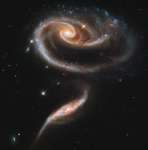 Peculiar Galaxies of Arp 273
21.04.2011
The spiky stars in the foreground of this sharp cosmic portrait are well within our own Milky Way Galaxy. The two eye-catching galaxies lie far beyond the Milky Way, at a distance of over 300 million light-years. Their distorted appearance is due to gravitational tides as the pair engage in close encounters.
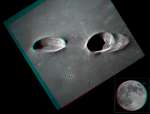 Messier Craters in Stereo
8.06.2013
Many bright nebulae and star clusters in planet Earth's sky are associated with the name of astronomer Charles Messier, from his famous 18th century catalog. His name is also given to these two large and remarkable craters on the Moon.
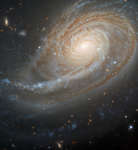 Arp 78: Peculiar Galaxy in Aries
24.03.2022
Peculiar spiral galaxy Arp 78 is found within the boundaries of the head strong constellation Aries. Some 100 million light-years beyond the stars and nebulae of our Milky Way galaxy, the island universe is over 100,000 light-years across.
|
January February March April May June July August September |
|||||||||||||||||||||||||||||||||||||||||||||||||