
|
You entered: universe
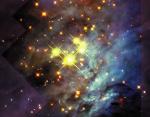 The Brown Dwarfs of Orions Trapezium
30.08.2000
The bright stars above are well known as heart of the Trapezium, an open cluster of stars in the center of the Orion Nebula. The many dim objects, however, are not well known, and have come to attention only on recent images in infrared light.
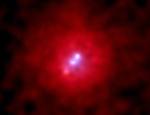 3C 295: X-rays From A Giant Galaxy
25.11.1999
Did this galaxy eat too much? Five billion light-years away, the giant elliptical galaxy 3C295 is a prodigious source of energy at radio wavelengths. Bright knots of X-ray emission are also seen at the center of this false-color Chandra Observatory image of the region.
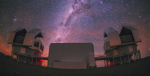 An Active Night over the Magellan Telescopes
21.02.2017
The night sky is always changing. Featured here are changes that occurred over a six hour period in late 2014 June behind the dual 6.5-meter Magellan Telescopes at Las Campanas Observatory in Chile.
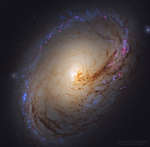 Spiral Galaxy M96 from Hubble
12.06.2019
Dust lanes seem to swirl around the core of Messier 96 in this colorful, detailed portrait of the center of a beautiful island universe. Of course M96 is a spiral galaxy, and counting...
 APOD: 2024 August 21 Б Fermis 12 year All Sky Gamma ray Map
21.08.2024
Forget X-ray vision Б imagine what you could see with gamma-ray vision! The featured all-sky map shows what the universe looks like to NASA's Fermi Gamma-ray Space Telescope. Fermi sees light with energies about a billion times what the human eye can see, and the map combines 12 years of Fermi observations.
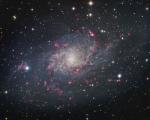 M33: Spiral Galaxy in Triangulum
24.09.2003
The small constellation Triangulum in the northern sky harbors this magnificent face-on spiral galaxy, M33. Its popular names include the Pinwheel Galaxy or just the Triangulum Galaxy. M33's diameter spans over 50,000 light-years, making it third largest in the Local Group of galaxies after the Andromeda Galaxy (M31), and our own Milky Way.
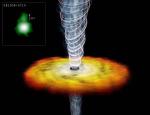 The Most Distant X Ray Jet
28.11.2003
A false-color x-ray image inset at upper left reveals emission from a cosmic jet of high-energy particles, 100,000 light-years in length, emerging from quasar GB1508+5714. An estimated 12 billion (12,000,000,000) light-years away, this appears to be the most distant energetic jet in the known Universe.
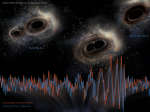 LIGO Detects Gravitational Waves from Merging Black Holes
11.02.2016
Gravitational radiation has been directly detected. The first-ever detection was made by both facilities of the Laser Interferometer Gravitational-Wave Observatory (LIGO) in Washington and Louisiana simultaneously last September. After numerous consistency checks, the resulting 5-sigma discovery was published today.
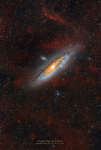 Clouds of Andromeda
4.01.2017
The beautiful Andromeda Galaxy is often imaged by planet Earth-based astronomers. Also known as M31, the nearest large spiral galaxy is a familiar sight with dark dust lanes, bright yellowish core, and spiral arms traced by blue starlight.
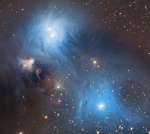 Stars and Dust in Corona Australis
18.10.2017
Blue dust clouds and young, energetic stars inhabit this telescopic vista, less than 500 light-years away toward the northern boundary of Corona Australis, the Southern Crown. The dust clouds effectively block light from more distant background stars in the Milky Way.
|
January February March April May June July August September |
|||||||||||||||||||||||||||||||||||||||||||||||||