
|
You entered: universe
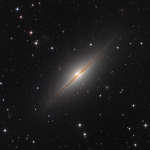 NGC 7814: Little Sombrero with Supernova
22.07.2021
Point your telescope toward the high flying constellation Pegasus and you can find this expanse of Milky Way stars and distant galaxies. NGC 7814 is centered in the pretty field of view that would almost be covered by a full moon.
 APOD: 2025 February 3 Б Wolf Rayet Star 124: Stellar Wind Machine
3.02.2025
Some stars explode in slow motion. Rare, massive Wolf-Rayet stars are so tumultuous and hot that they are slowly disintegrating right before our telescopes. Glowing gas globs each typically over 30 times more massive than the Earth are being expelled by violent stellar winds.
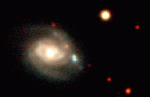 Star Wars in NGC 664
25.02.1997
Long ago in a galaxy far, far away, locked in their final desperate struggle against the force of gravity ... two stars exploded! Stellar explosions - Supernovae - are among the most powerful events in the Universe, estimated to release an equivalent energy of up to 1 million trillion trillion (1 followed by 30 zeros) megatons of TNT.
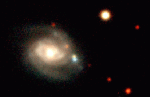 Star Wars in NGC 664
18.04.1998
Long ago in a galaxy far, far away, locked in their final desperate struggle against the force of gravity ... two stars exploded! stellar explosions - Supernovae - are among the most powerful events in the Universe, estimated to release an equivalent energy of up to 1 million trillion trillion (1 followed by 30 zeros) megatons of TNT.
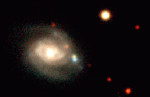 Star Wars in NGC 664
15.05.1999
Long ago in a galaxy far, far away, locked in their final desperate struggle against the force of gravity ... two stars exploded! stellar explosions - Supernovae - are among the most powerful events in the Universe, estimated to release an equivalent energy of up to 1 million trillion trillion (1 followed by 30 zeros) megatons of TNT.
 The Cloudy Cores of Active Galaxies
24.02.2014
What would it look like to travel to the center of an active galaxy? Most galactic centers are thought to house black holes millions of times more massive than our Sun. The spaces surrounding...
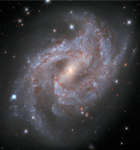 Supernova in NGC 2525
23.10.2020
Big, beautiful, barred spiral galaxy NGC 2525 lies 70 million light-years from the Milky Way. It shines in Earth's night sky within the boundaries of the southern constellation Puppis. About 60,000 light-years...
 North Star: Polaris and Surrounding Dust
28.04.2021
Why is Polaris called the North Star? First, Polaris is the nearest bright star toward the north spin axis of the Earth. Therefore, as the Earth turns, stars appear to revolve around Polaris, but Polaris itself always stays in the same northerly direction -- making it the North Star.
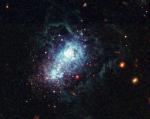 I Zwicky 18: Young Galaxy
3.12.2004
The Milky Way is an ordinary 12 billion year old spiral galaxy, and even our middle-aged Sun is pushing 4.5 billion years. But all the stars in dwarf galaxy I Zwicky 18 are much younger.
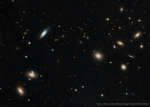 Inside the Coma Cluster of Galaxies
28.02.2015
Almost every object in the above photograph is a galaxy. The Coma Cluster of Galaxies pictured above is one of the densest clusters known - it contains thousands of galaxies. Each of these galaxies houses billions of stars - just as our own Milky Way Galaxy does.
|
January February March April May June July August September |
|||||||||||||||||||||||||||||||||||||||||||||||||