
|
You entered: universe
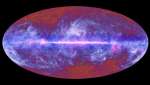 Microwave Milky Way
9.07.2010
Seen from our edge-on perspective, the Milky Way Galaxy sprawls across the middle of this false-color, all sky view. The expansive microwave map is based on 1 year's worth of data from instruments onboard the sky-surveying Planck spacecraft.
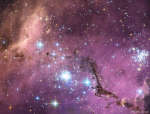 N11: Star Clouds of the LMC
29.04.2019
Massive stars, abrasive winds, mountains of dust, and energetic light sculpt one of the largest and most picturesque regions of star formation in the Local Group of Galaxies. Known as N11, the region...
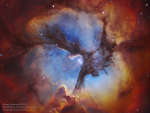 In the Center of the Trifid Nebula
1.11.2020
What's happening at the center of the Trifid Nebula? Three prominent dust lanes that give the Trifid its name all come together. Mountains of opaque dust appear near the bottom, while other dark filaments of dust are visible threaded throughout the nebula.
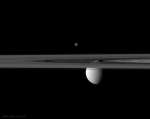 Moons Beyond Rings at Saturn
4.01.2022
What's happened to that moon of Saturn? Nothing -- Saturn's moon Rhea is just partly hidden behind Saturn's rings. In 2010, the robotic Cassini spacecraft then orbiting Saturn took this narrow-angle view looking across the Solar System's most famous rings.
 APOD: 2023 May 8 Б The Spanish Dancer Spiral Galaxy
8.05.2023
If not perfect, then this spiral galaxy is at least one of the most photogenic. An island universe containing billions of stars and situated about 40 million light-years away toward the constellation of the Dolphinfish (Dorado), NGC 1566 presents a gorgeous face-on view.
 Galaxy Cluster Abell 370 and Beyond
12.09.2023
Some 4 billion light-years away, massive galaxy cluster Abell 370 is captured in this sharp Hubble Space Telescope snapshot. The cluster of galaxies only appears to be dominated by two giant elliptical galaxies and infested with faint arcs.
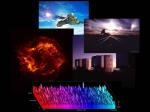 A Year of New Perspectives
28.12.1999
Fittingly, 1999 saw a decade of astronomical discoveries to an end with portents of things to come - embodied in new spacecraft, telescopes, and perspectives to explore the distant Universe across the electromagnetic spectrum. X-ray astronomy in particular will likely flourish in coming
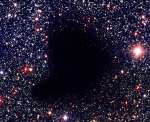 Molecular Cloud Barnard 68
29.01.2012
Where did all the stars go? What used to be considered a hole in the sky is now known to astronomers as a dark molecular cloud. Here, a high concentration of dust and molecular gas absorb practically all the visible light emitted from background stars.
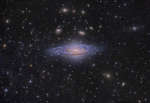 NGC 7331 and Beyond
17.12.2014
Big, beautiful spiral galaxy NGC 7331 is often touted as an analog to our own Milky Way. About 50 million light-years distant in the northern constellation Pegasus, NGC 7331 was recognized early on as a spiral nebula and is actually one of the brighter galaxies not included in Charles Messier's famous 18th century catalog.
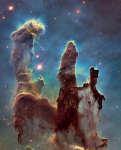 Hubble 25th Anniversary: Pillars of Creation
6.01.2015
To celebrate 25 years (1990-2015) of exploring the Universe from low Earth orbit, the Hubble Space Telescope's cameras were used to revisit its most iconic image. The result is this sharper, wider view of the region dubbed the Pillars of Creation, first imaged by Hubble in 1995.
|
January February March April May |
|||||||||||||||||||||||||||||||||||||||||||||||||