
|
You entered: telescope
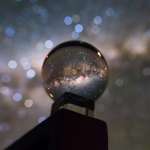 Galaxy in a Crystal Ball
22.06.2018
A small crystal ball seems to hold a whole galaxy in this creative snapshot. Of course, the galaxy is our own Milky Way. Its luminous central bulge marked by rifts of interstellar dust spans thousands of light-years. On this long southern hemisphere night it filled dark Chilean skies over Paranal Observatory.
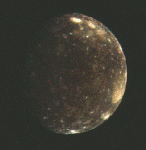 Callisto: Dark Smashed Iceball
6.09.1995
Callisto is a dirty battered world, showing the most beaten surface of Jupiter's major moons. Made of a rocky core covered by fractured ice, Callisto's past collisions with large meteors are evident as large craters surrounded by concentric rings.
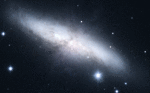 Unusual M82: The Cigar Galaxy
18.11.1996
Something strange happened to this galaxy, but what? M82 is a nearby galaxy in the group of galaxies dominated by itself, M81, and NGC 3077. M82 is thought by some to be limping away from a close encounter with M81.
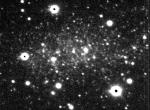 The Aquarius Dwarf
27.07.2003
Our Milky Way Galaxy is not alone. It is part of a gathering of about 50 galaxies known as the Local Group. Members include the Great Andromeda Galaxy (M31), M32, M33, the Large Magellanic Cloud, the Small Magellanic Cloud, Dwingeloo 1, several small irregular galaxies, and many dwarf elliptical and dwarf spheroidal galaxies.
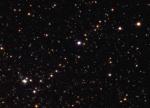 Kembles Cascade
14.08.2000
A picturesque chain of unrelated stars is visible with strong binoculars towards the constellation of Camelopardalis. Known as Kemble's Cascade, the asterism contains about 20 stars nearly in a row stretching over five times the width of a full moon.
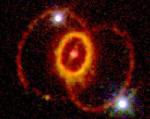 The Mysterious Rings of Supernova 1987A
31.03.2002
What's causing those odd rings in supernova 1987A? In 1987, the brightestsupernova in recent history occurred in the Large Magellanic Clouds. At the center of the picture is an object central to the remains of the violent stellar explosion.
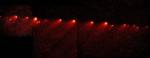 A String Of Pearls
23.03.1997
Comet Shoemaker-Levy 9, named after its co-discoverers, was often referred to as the "string of pearls" comet. It is famous for its unusual appearance as well as its collision with the planet Jupiter!
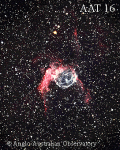 A Wolf Rayet Star Bubble
28.09.1997
What's a Wolf-Rayet star, and how did it create that spherical bubble and sweeping arc? A Wolf-Rayet star is a star that originated with a mass over 40 times that of our Sun.
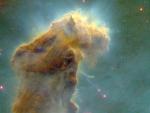 Eagle EGGs in M16
12.08.2001
Star forming regions known as "EGGs" are uncovered at the end of this giant pillar of gas and dust in the Eagle Nebula (M16). EGGs, short for evaporating gaseous globules, are dense regions of mostly molecular hydrogen gas that fragment and gravitationally collapse to form stars.
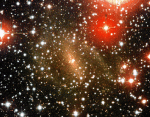 Galaxy Dwingeloo 1 Emerges
17.10.1995
If you look closely at the center of the above photograph, you will see a spiral galaxy behind the field of stars. Named Dwingeloo 1, this nearby galaxy was only discovered recently (1994) because much of its light was obscured by dust, gas and bright stars of our own Milky Way galaxy.
|
January February |
|||||||||||||||||||||||||||||||||||||||||||||||||