
|
You entered: telescope
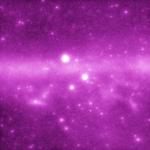 GLAST Gamma Ray Sky Simulation
12.11.1998
This simulated image models the intensities of gamma rays with over 40 million times the energy of visible light, and represents how the sky might appear to the proposed Gamma-ray Large Area Space Telescope (GLAST) after its first year in orbit.
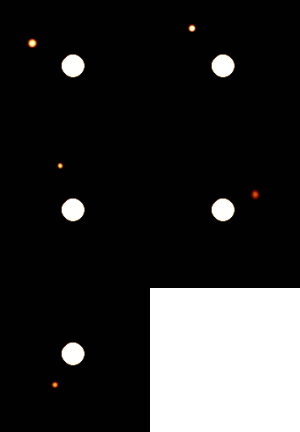 Moon Over Eugenia
14.10.1999
Eugenia is an asteroid with a moon! This animation was constructed from infrared discovery images of the Eugenia-moon system taken in November 1998 using the Canada-France-Hawaii Telescope (CFHT). Main belt asteroid Eugenia, represented here as a central white patch, is a mere 215 kilometers in diameter.
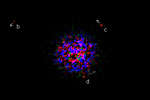 HR 8799: Discovery of a Multi planet Star System
17.11.2008
How common are planetary systems like our own Solar System? In the twelve years previous to 2008, over 300 candidate planetary systems have been found orbiting nearby stars. None, however, were directly imaged, few showed evidence for multiple planets, and many had a Jupiter-sized planet orbiting inside the orbit of Mercury.
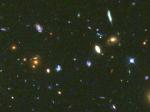 Distant Galaxies
22.06.1997
This Hubble Space Telescope image of a group of faint galaxies "far, far away" is a snap shot of the Universe when it was young. The bluish, irregularly shaped galaxies revealed in the image are up to eight billion light years away and seem to have commonly undergone galaxy collisions and bursts of star formation.
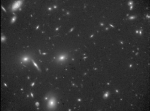 A Distant Cluster of Galaxies
14.01.1996
Every bright object in this 1994 photograph by the Hubble Space Telescope is a galaxy. Oddly - most of the objects are spiral galaxies. This rich cluster of galaxies, named CL 0939+4713, is almost half way across the visible universe.
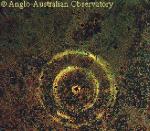 Echoes of Supernova 1987A
23.10.1997
Can you find Supernova 1987a? It's not hard - it occurred in the center of the bulls-eye pattern. Although this stellar detonation was seen more than a decade ago, light from it continues to bounce off nearby interstellar dust and be reflected to us. These two rings are thus echoes of the powerful supernova.
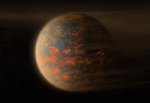 Cancri 55 e: Climate Patterns on a Lava World
5.04.2016
Why might you want to visit super-earth Cancri 55 e? Its extremely hot climate would be a deterrent, as mornings on this world might bring fresh lava flows. Discovered in 2004, the planet Cancri 55 e has twice the diameter of our Earth and about 10 times Earth's mass.
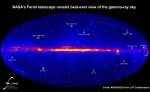 Fermi s Gamma Ray Sky
21.03.2009
Scanning the entire sky in gamma-rays, photons with over 50 million times the energy of visible light, the Fermi mission's Large Area Telescope (LAT) explores the high-energy universe. This all-sky map constructed from...
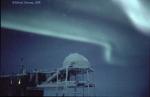 Aurora Over Antarctica
20.03.2002
Looking out from the bottom of the world, strange and spectacular sights are sometimes observed. Such was the case during the long Antarctic night of 1998, as awesome aurora sub-storms were photographed above scientific outposts. Visible in the left foreground of the above photograph is the Martin A.
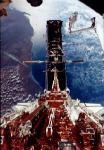 Orbiting Repairmen
28.01.1996
In December of 1993 astronauts Story Musgrave and Jeffrey Hoffman performed the orbiting repairmans' ballet 400 miles above the Earth. They are seen in this photo perched at the end of the Space Shuttle Endeavour's robotic arm making final repairs to the four story tall Hubble Space Telescope.
|
January February March April May |
|||||||||||||||||||||||||||||||||||||||||||||||||