
|
You entered: telescope
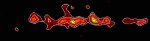 Radioactive Clouds in the Milky Way
29.10.1995
When massive stars explode they create large radioactive blast clouds which expand into interstellar space. As the radioactive elements decay, they produce gamma-rays. Possible locations of these stellar explosions known as supernovae, are indicated by the bright clumps in this map of the central regions of our Milky Way Galaxy.
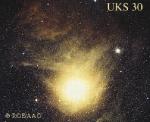 Antares
24.06.1997
Antares is a huge star. In a class called red supergiant, Antares is about 700 times the size of our own Sun, 15 times more massive, and 10,000 times brighter. Antares is the brightest star in the constellation of Scorpius and one of the brighter stars in all the night sky.
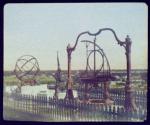 Beijing Ancient Observatory
6.05.1998
Did observatories exist before telescopes? One example that still stands today is the Beijing Ancient Observatory in China. Starting in the 1400s astronomers erected large instruments here to enable them to measure star and planet positions with increasing accuracy.
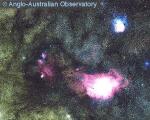 The Sky Towards Sagittarius
7.09.1998
A variety of stars and nebulae can be found towards the constellation of Sagittarius. Dense fields of stars laced with dark lanes of dust crowd this region only a few degrees from the center of our Galaxy.
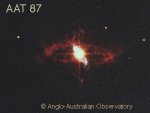 Symbiotic Star System R Aquarii
4.01.1996
Sometimes stars work together to create a spectacular display. Such is the case with the binary star system R Aquarii - a "symbiotic" star system. Here two stars, a variable giant and a white dwarf companion - create both a nebula and a jet.
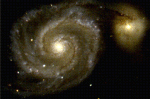 M51: The Whirlpool Galaxy
25.01.1997
The Whirlpool Galaxy is a classic spiral galaxy. At only 15 million light years distant, M51, also cataloged as NGC 5194, is one of the brighter and more picturesque galaxies on the sky.
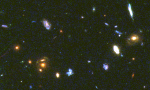 Distant Galaxies
7.09.1995
This Hubble Space Telescope image of a group of faint galaxies "far, far away" is a snap shot of the Universe when it was young. The bluish, irregularly shaped galaxies revealed in the image are up to eight billion light years away and seem to have commonly undergone galaxy collisions and bursts of star formation.
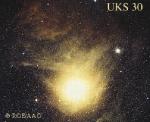 Antares
26.07.1998
Antares is a huge star. In a class called red supergiant, Antares is about 700 times the diameter of our own Sun, 15 times more massive, and 10,000 times brighter. Antares is the brightest star in the constellation of Scorpius and one of the brighter stars in all the night sky.
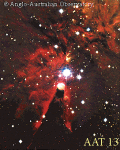 A Mysterious Cone Nebula
1.03.1996
Sometimes the simplest shapes are the hardest to explain. For example, the origin of the mysterious cone-shaped region located just below the center of the above picture remains a mystery. The dark region clearly contains much dust which blocks light from the emission nebula and open cluster NGC 2264 behind it.
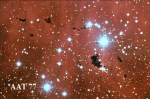 Dark Bok Globules in IC 2944
6.10.1995
The dark spots in the above picture are not photographic defects but an unusual type of interstellar cloud known as a Bok globule. Bok globules, named after astronomer Bart Bok who studied them extensively, are small dark clouds made of gas and dust that are typically condensing to form a star or stars.
|
January February March April May |
|||||||||||||||||||||||||||||||||||||||||||||||||