
|
You entered: telescope
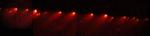 A String Of Pearls
25.05.2002
Comet Shoemaker-Levy 9, named after its co-discoverers, was often referred to as the "string of pearls" comet. It is famous for its suggestive appearance as well as its collision with the planet Jupiter!
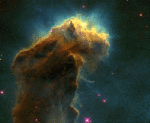 Eagle EGGs in M16
6.11.1995
Star forming regions known as "EGGs" are uncovered at the end of this giant pillar of gas and dust in the Eagle Nebula (M16). EGGs, short for evaporating gaseous globules, are dense regions of mostly molecular hydrogen gas that fragment and gravitationally collapse to form stars.
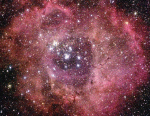 Star Cluster in the Rosette Nebula
22.05.1996
Embedded in the center of the colorful and photogenic Rosette Nebula is a bright, young open cluster. The bright blue stars in this cluster, labelled NGC 2244, emit ultraviolet light that knocks electrons away from hydrogen atoms.
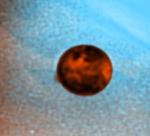 Eruption on Io
23.06.1997
There it goes again. Gas and rock were catapulted hundreds of kilometers into space as Jupiter's most volatile moon, Io, showed yet another impressive volcanic display in this just-released photograph by the Hubble Space Telescope.
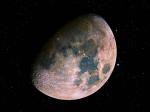 Colorful Moon Mosaic
7.09.2006
No single exposure can easily capture faint stars along with the subtle colors of the Moon. But this dramatic composite view highlights both. The mosaic digitally stitches together fifteen carefully exposed high resolution images of a bright, gibbous Moon and a representative background star field.
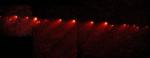 A String Of Pearls
14.08.1999
Comet Shoemaker-Levy 9, named after its co-discoverers, was often referred to as the "string of pearls" comet. It is famous for its suggestive appearance as well as its collision with the planet Jupiter!
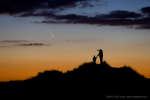 Comet PANSTARRS Just After Sunset
18.03.2013
Have you seen the comet? As Comet PANSTARRS fades, careful observers -- even with unaided eyes -- should still be able to find the shedding ice ball on the western horizon just after sunset. Pictured above, Comet PANSTARRS (C/2011 L4) was pointed out from a hilltop last week on First Encounter Beach in Massachusetts, USA.
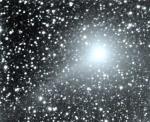 Comet Williams in 1998
6.10.1998
The brightest comet in the sky right now is Comet Williams. Moving slowly though the constellation of Centaurus, Comet Williams, at magnitude 8, is visible to Southern Hemisphere observers with binoculars. In ten days...
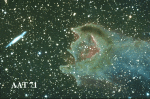 CG4: A Ruptured Cometary Globule
4.10.1995
The odd looking "creature" to the right of center in the above photo is a gas cloud known as a cometary globule. This globule, however, has ruptured. Cometary globules are typically characterized by dusty heads and elongated tails.
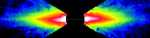 The Dusty Disk of Beta Pic
18.01.1996
This dusty disk, viewed edge on surrounding Beta Pictoris, a star only 50 lightyears distant, may signal the presence of an infant solar system. Beta Pictoris is a young Sun-like star just completing its formative stages.
|
January February March April May |
|||||||||||||||||||||||||||||||||||||||||||||||||