
|
You entered: telescope
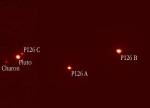 Pluto and Charon Eclipse a Triple Star
11.09.2002
Occasionally, a planet in our Solar System will pass in front of a bright star. Since stars and planets take up so little space on the sky, such events are quite rare. Two months ago, however, Pluto and its large moon Charon passed in front of a comparatively bright triple star system known as P126.
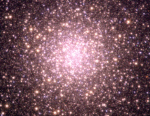 Globular Cluster M3
6.12.1996
This huge ball of stars predates our Sun. Long before mankind evolved, before dinosaurs roamed, and even before our Earth existed, ancient globs of stars condensed and orbited a young Milky Way Galaxy.
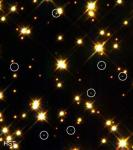 White Dwarf Stars Cool
2.11.1997
Diminutive by stellar standards, white dwarf stars are also intensely hot ... but they are cooling. No longer do their interior nuclear fires burn, so they will continue to cool until they fade away. This Hubble Space Telescope image covers a small region near the center of a globular cluster known as M4.
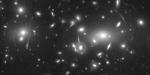 Abell 2218: A Galaxy Cluster Lens
11.01.1998
Gravity can bend light. Almost all of the bright objects in this Hubble Space Telescope image are galaxies in the cluster known as Abell 2218. The cluster is so massive and so compact that its gravity bends and focuses the light from galaxies that lie behind it.
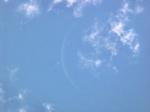 Crescent Venus and Moon
30.10.2006
There's something behind these clouds. Those faint graceful arcs, upon inspection, are actually far, far in the distance. They are the Earth's Moon and the planet Venus. Both the Moon and Venus are bright enough to be seen during the day, and both are quite capable of showing a crescent phase.
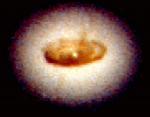 The Heart Of NGC 4261
19.10.1997
What evil lurks in the hearts of galaxies? This Hubble Space Telescope picture of the center of the nearby elliptical galaxy NGC 4261 tells one dramatic tale. The gas and dust in this disk are swirling into what is almost certainly a massive black hole.
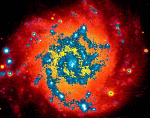 M74: A Grand Design Spiral Galaxy
9.07.1996
M74 is about the same size as our own Milky Way Galaxy. Like our Milky Way, M74 is classified a spiral galaxy. M74's sweeping lanes of stars and dust combined with its small nucleus make it a classic Grand Design Spiral. On the Hubble Sequence of Galaxies, M74 is listed as "Sc".
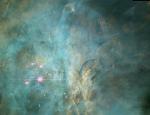 In the Center of the Trapezium
2.03.2003
Start with the constellation of Orion. Near Orion's belt is a fuzzy area known as the Great Nebula of Orion or M42. In this nebula is a bright star cluster known as the Trapezium, shown above. New stellar systems are forming there in gigantic globs of gas and dust known as Proplyds.
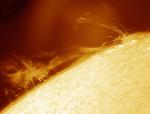 At the Edge of the Sun
7.07.2003
Dramatic prominences can sometimes be seen looming just beyond the edge of the sun. A solar prominence is a cloud of solar gas held just above the surface by the Sun's magnetic field. The Earth would easily fit below the prominence on the left.
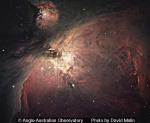 Water From Orion
21.04.1998
Is Orion all wet? Recent observations have confirmed that water molecules now exist in the famous Orion Nebula, and are still forming. The Orion Nebula (M42, shown above) is known to be composed mostly of hydrogen gas, with all other atoms and molecules being comparatively rare.
|
January February March April May |
|||||||||||||||||||||||||||||||||||||||||||||||||