
|
You entered: disk
 Southern Annular Eclipse
26.04.2014
It's eclipse season, and on April 29 around 06:00 UT the shadow of the new Moon will reach out and touch planet Earth, though only just. Still, if you're standing...
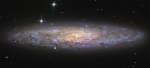 NGC 253: Dusty Island Universe
22.03.2018
Shiny NGC 253 is one of the brightest spiral galaxies visible, and also one of the dustiest. Some call it the Silver Dollar Galaxy for its appearance in small telescopes, or just the Sculptor Galaxy for its location within the boundaries of the southern constellation Sculptor.
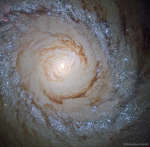 Starburst Galaxy M94 from Hubble
31.07.2022
Why does this galaxy have a ring of bright blue stars? Beautiful island universe Messier 94 lies a mere 15 million light-years distant in the northern constellation of the Hunting Dogs (Canes Venatici).
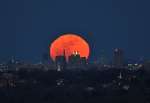 Boston Moonrise
24.03.2011
Last week's Full Moon was hard to miss. Rising on March 19, its exact full phase occurred within an hour of perigee, the closest point in the Moon's orbit to Earth.
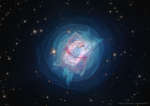 Bright Planetary Nebula NGC 7027 from Hubble
30.06.2020
What created this unusual planetary nebula? NGC 7027 is one of the smallest, brightest, and most unusually shaped planetary nebulas known. Given its expansion rate, NGC 7027 first started expanding, as visible from Earth, about 600 years ago.
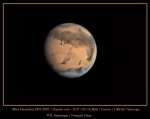 Mars in View
6.12.2007
Very good telescopic views of Mars can be expected in the coming weeks as the Red Planet nears opposition on December 24th. Of course, opposition means opposite the Sun in planet Earth's sky - an arrangement that occurs every 26 months for Mars.
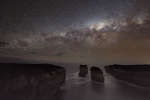 A Milky Way Shadow at Loch Ard Gorge
23.08.2010
Have you ever seen the Milky Way's glow create shadows? To do so, conditions need to be just right. First and foremost, the sky must be relatively clear of clouds so that the long band of the Milky Way's central disk can be seen.
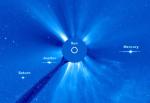 Planets In The Sun
5.05.2000
Today, all five naked-eye planets (Mercury, Venus, Mars, Jupiter, Saturn) plus the Moon and the Sun will at least approximately line-up. As viewed from planet Earth, they will be clustered within about 26 degrees, the closest alignment for all these celestial bodies since February 1962, when there was a solar eclipse!
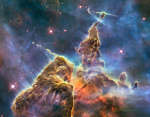 Dust Pillar of the Carina Nebula
26.04.2010
Inside the head of this interstellar monster is a star that is slowly destroying it. The monster, on the right, is actually an inanimate pillar of gas and dust that measures over a light year in length.
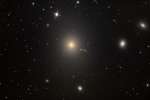 M87: Elliptical Galaxy with Jet
20.05.2010
In spiral galaxies, majestic winding arms of young stars, gas, and dust rotate in a flat disk around a bulging galactic nucleus. But elliptical galaxies seem to be simpler. Lacking gas and dust to form new stars, their randomly swarming older stars, give them an ellipsoidal (egg-like) shape. Still, elliptical galaxies can be very large.
|
January February March April May June July August September |
|||||||||||||||||||||||||||||||||||||||||||||||||