
|
You entered: disk
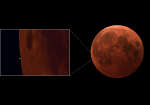 Blood Moon, Ice Giant
11.11.2022
On November 8 the Full Moon turned blood red as it slid through Earth's shadow in a beautiful total lunar eclipse. During totality it also passed in front of, or occulted, outer planet Uranus for eclipse viewers located in parts of northern America and Asia.
 APOD: 2025 August 31 Б NGC 7027: The Pillow Planetary Nebula
31.08.2025
What created this unusual planetary nebula? Dubbed the Pillow Nebula and the Flying Carpet Nebula, NGC 7027 is one of the smallest, brightest, and most unusually shaped planetary nebulas known. Given its expansion rate, NGC 7027 first started expanding, as visible from Earth, about 600 years ago.
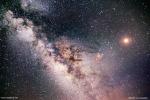 The Milky Way Behind an Eclipsed Moon
3.06.2003
What's behind the Moon? Each month, our Moon passes in front of -- and outshines -- many an interesting star field. Exceptions occur during a new Moon and during a total eclipse. In the background...
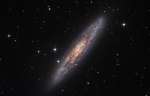 NGC 253: Dusty Island Universe
26.07.2014
Shiny NGC 253 is one of the brightest spiral galaxies visible, and also one of the dustiest. Some call it the Silver Dollar Galaxy for its appearance in small telescopes, or just the Sculptor Galaxy for its location within the boundaries of the southern constellation Sculptor.
 Webb s Rho Ophiuchi
13.07.2023
A mere 390 light-years away, Sun-like stars and future planetary systems are forming in the Rho Ophiuchi molecular cloud complex, the closest star-forming region to our fair planet. The James Webb Space Telescope's NIRCam peered into the nearby natal chaos to capture this infrared image at an inspiring scale.
 Elliptical M60, Spiral NGC 4647
14.09.2012
Giant elliptical galaxy M60 and spiral galaxy NGC 4647 do look like an odd couple in this sharp cosmic portrait from the Hubble Space Telescope. But they are found in a region of space where galaxies tend to gather, on the eastern side of the nearby Virgo Galaxy Cluster.
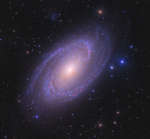 Bright Spiral Galaxy M81
17.10.2015
One of the brightest galaxies in planet Earth's sky is similar in size to our Milky Way Galaxy: big, beautiful M81. The grand spiral galaxy can be found toward the northern constellation of the Great Bear (Ursa Major).
 The Tulip and Cygnus X 1
16.02.2017
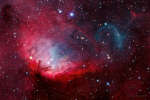
Framing a bright emission region, this telescopic view looks out along the plane of our Milky Way Galaxy toward the nebula rich constellation Cygnus the Swan. Popularly called the Tulip Nebula, the reddish glowing cloud of interstellar gas and dust is also found in the 1959 catalog by astronomer Stewart Sharpless as Sh2-101.
 Solar Surfin
16.07.1999
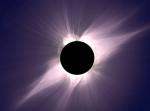
The sun's corona is a tenuous outer atmosphere composed of streams of energetic charged particles, but it is only easily seen from Earth during a total solar eclipse. For example, this 1991 image of totality from atop Mauna Kea, Hawaii forms a fleeting snapshot of the mysterious corona's beautiful, intricate structures and streams.
 NGC 4651: The Umbrella Galaxy
15.04.2010
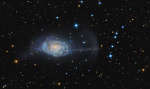
Spiral galaxy NGC 4651 is a mere 35 million light-years distant, toward the well-groomed constellation Coma Berenices. About 50 thousand light-years across, this galaxy is seen to have a faint umbrella-shaped structure (right) that seems to extend some 50 thousand light-years farther, beyond the bright galactic disk.
|
January February March April May June July August |
||||||||||||||||||||||||||||||||||||||||||||||||||||||||