
|
You entered: disk
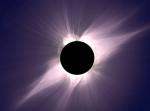 Solar Surfin
16.07.1999
The sun's corona is a tenuous outer atmosphere composed of streams of energetic charged particles, but it is only easily seen from Earth during a total solar eclipse. For example, this 1991 image of totality from atop Mauna Kea, Hawaii forms a fleeting snapshot of the mysterious corona's beautiful, intricate structures and streams.
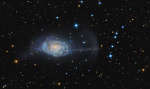 NGC 4651: The Umbrella Galaxy
15.04.2010
Spiral galaxy NGC 4651 is a mere 35 million light-years distant, toward the well-groomed constellation Coma Berenices. About 50 thousand light-years across, this galaxy is seen to have a faint umbrella-shaped structure (right) that seems to extend some 50 thousand light-years farther, beyond the bright galactic disk.
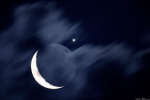 Moon Meets Jupiter
10.07.2016
What's that next to the Moon? Jupiter -- and its four largest moons. Skygazers around planet Earth enjoyed the close encounter of planets and Moon in 2012 July 15's predawn skies. And while...
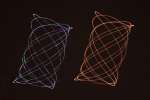 Scintillating
28.04.2011
On June 4, 2010 Regulus, alpha star of the constellation Leo, and wandering planet Mars were at about the same apparent brightness, separated on the sky by 1.5 degrees. An ingenious and creative 10 second exposure from a swinging camera recorded these gyrating trails of the celestial pairing.
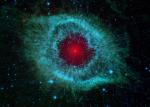 APOD: 2007 February 23- Dust and the Helix Nebula
23.02.2007
Dust makes this cosmic eye look red. The eerie Spitzer Space Telescope image shows infrared radiation from the well-studied Helix Nebula (NGC 7293) a mere 700 light-years away in the constellation Aquarius.
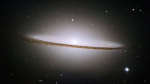 The Sombrero Galaxy from Hubble
15.05.2011
What's going on in the center of this spiral galaxy? Named the Sombrero Galaxy for its hat-like resemblance, M104 features a prominent dust lane and a bright halo of stars and globular clusters.
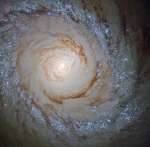 Starburst Galaxy Messier 94
23.10.2015
Beautiful island universe Messier 94 lies a mere 15 million light-years distant in the northern constellation of the hunting dogs, Canes Venatici. A popular target for earth-based astronomers, the face-on spiral galaxy is about 30,000 light-years across, with spiral arms sweeping through the outskirts of its broad disk.
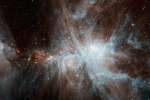 Spitzer's Orion
31.08.2019
Few cosmic vistas excite the imagination like the Orion Nebula, an immense stellar nursery some 1,500 light-years away. Spanning about 40 light-years across the region, this infrared image from the Spitzer Space Telescope...
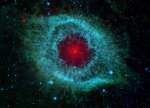 Dust and the Helix Nebula
31.12.2009
Dust makes this cosmic eye look red. The eerie Spitzer Space Telescope image shows infrared radiation from the well-studied Helix Nebula (NGC 7293) a mere 700 light-years away in the constellation Aquarius.
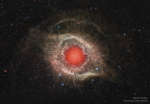 The Helix Nebula in Infrared
20.09.2016
What makes this cosmic eye look so red? Dust. The featured image from the robotic Spitzer Space Telescope shows infrared light from the well-studied Helix Nebula (NGC 7293) a mere 700 light-years away in the constellation of the Water Carrier Aquarius.
|
January February March April May June July August September |
|||||||||||||||||||||||||||||||||||||||||||||||||