
|
You entered: disk
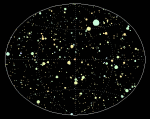 Gamma Ray Bursts from the Unknown
27.08.1995
Gamma Ray Bursts (GRBs) pose one of the greatest mysteries of modern astronomy. About once a day, the gamma-ray sky lights up with a spectacular explosion. No one knows what causes these explosions or even how far away they are.
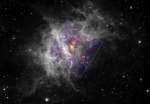 Young Star Cluster Westerlund 2
26.06.2010
Dusty stellar nursery RCW 49 surrounds young star cluster Westerlund 2 in this remarkable composite skyscape from beyond the visible spectrum of light. Infrared data from the Spitzer Space Telescope is shown in black...
 The North America Nebula in Infrared
15.02.2011
The North America Nebula can do what most North Americans cannot -- form stars. Precisely where in the nebula these stars are forming has been mostly obscured by some of the nebula's thick dust that is opaque to visible light.
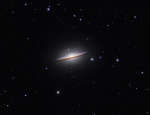 The Sombrero Galaxy from Hale
15.07.2013
What's going on in the center of this spiral galaxy? Named the Sombrero Galaxy for its hat-like resemblance, M104 features a prominent dust lane and a bright halo of stars and globular clusters.
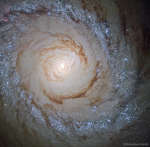 Starburst Galaxy M94 from Hubble
1.12.2019
Why does this galaxy have a ring of bright blue stars? Beautiful island universe Messier 94 lies a mere 15 million light-years distant in the northern constellation of the Hunting Dogs (Canes Venatici).
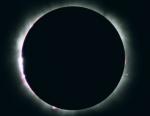 Total Eclipse of the Active Sun
20.06.2001
A total eclipse of the Sun is that special geocentric celestial event where the Moon passes exactly in front of the solar disk. During a fleeting few minutes of totality, fortunate earthdwellers located within...
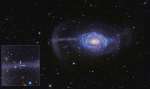 NGC 4651: The Umbrella Galaxy
2.07.2014
Spiral galaxy NGC 4651 is a mere 62 million light-years distant, toward the well-groomed northern constellation Coma Berenices. About the size of our Milky Way, this island universe is seen to have a faint umbrella-shaped structure that seems to extend (left) some 100 thousand light-years beyond the bright galactic disk.
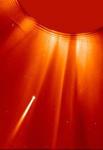 SOHO Sungrazer
1.09.2000
SOHO, the space-based SOlar and Heliospheric Observatory, has become by far the reigning champion facility for discovering comets, its total having recently reached 200. As might be expected of a solar observatory, most of the SOHO discovered comets are sungrazers, destined to dive within a mere 50 thousand kilometers or so of the solar photosphere.
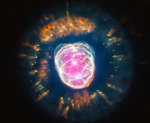 The Eskimo Nebula from Hubble and Chandra
30.07.2013
In 1787, astronomer William Herschel discovered the Eskimo Nebula. From the ground, NGC 2392 resembles a person's head surrounded by a parka hood. In 2000, the Hubble Space Telescope imaged the Eskimo Nebula in visible light, while the nebula was imaged in X-rays by the Chandra X-ray Observatory in 2007.
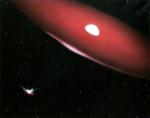 Phi Persei: Double Star
2.10.1999
It's clear who is the biggest star in this binary system. Based on recent results, this artist's vision of the double star Phi Persei, 720 light years away, shows a bright, rapidly rotating massive star surrounded by a disk of gas. A small companion star orbits 100 million miles away.
|
January February March April May June July August September |
|||||||||||||||||||||||||||||||||||||||||||||||||