
|
You entered: wind
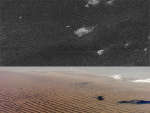 The Sand Dunes of Titan
10.08.2010
Why do some sand dunes on Titan appear backwards? Central Titan, it turns out, is covered by sand, some of which appears strange. Images from the Cassini spacecraft currently orbiting Saturn have uncovered long rows of huge sand dunes near Titan's equator that rise as high as 300 meters.
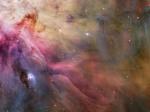 LL Ori and the Orion Nebula
19.01.2006
This esthetic close-up of cosmic clouds and stellar winds features LL Orionis, interacting with the Orion Nebula flow. Adrift in Orion's stellar nursery and still in its formative years, variable star LL Orionis produces a wind more energetic than the wind from our own middle-aged Sun.
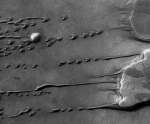 Flowing Barchan Sand Dunes on Mars
22.04.2012
When does Mars act like a liquid? Although liquids freeze and evaporate quickly into the thin atmosphere of Mars, persistent winds may make large sand dunes appear to flow and even drip like a liquid.
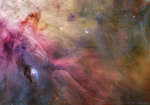 LL Ori and the Orion Nebula
17.02.2018
Stars can make waves in the Orion Nebula's sea of gas and dust. This esthetic close-up of cosmic clouds and stellar winds features LL Orionis, interacting with the Orion Nebula flow. Adrift...
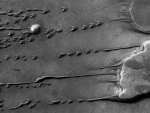 Flowing Barchan Sand Dunes on Mars
20.04.2009
When does Mars act like a liquid? Although liquids freeze and evaporate quickly into the thin atmosphere of Mars, persistent winds may make large sand dunes appear to flow and even drip like a liquid.
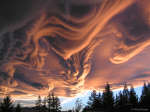 Asperatus Clouds Over New Zealand
16.04.2016
What kind of clouds are these? Although their cause is presently unknown, such unusual atmospheric structures, as menacing as they might seem, do not appear to be harbingers of meteorological doom. Known informally...
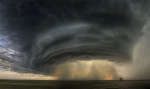 A Supercell Thunderstorm Cloud Over Montana
29.11.2010
Is that a spaceship or a cloud? Although it may seem like an alien mothership, it's actually a impressive thunderstorm cloud called a supercell. Such colossal storm systems center on mesocyclones -- rotating updrafts that can span several kilometers and deliver torrential rain and high winds including tornadoes.
 NGC 6888: The Crescent Nebula
27.11.2025
NGC 6888, also known as the Crescent Nebula, is a about 25 light-years across, a cosmic bubble blown by winds from its central, massive star. This deep telescopic image includes narrowband image data, to isolate light from hydrogen and oxygen atoms.
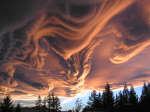 Asperatus Clouds Over New Zealand
27.02.2013
What kind of clouds are these? Although their cause is presently unknown, such unusual atmospheric structures, as menacing as they might seem, do not appear to be harbingers of meteorological doom. Known informally...
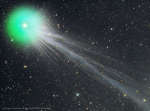 The Complex Ion Tail of Comet Lovejoy
20.01.2015
What causes the structure in Comet Lovejoy's tail? Comet C/2014 Q2 (Lovejoy), which is currently at naked-eye brightness and near its brightest, has been showing an exquisitely detailed ion tail. As the name...
|
January February March April May June July August September October November |
||||||||||||||||||||||||||||||||||||||||||||||||||||||||