
|
You entered: wind
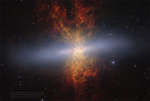 APOD: 2026 June 29 Б M82: Galaxy with a Supergalactic Wind
29.06.2026
Why is the Cigar Galaxy billowing red smoke? M82, as this starburst galaxy is also known, was stirred up by a recent pass near large spiral galaxy M81. This doesn't fully explain the source of the red-glowing outwardly expanding gas and dust, however.
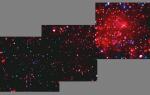 X Ray Stars and Winds in the Rosette Nebula
19.10.2001
This mosaic of x-ray images cuts a swath across the photogenic Rosette Nebula, a stellar nursery 5,000 light-years from Earth in the constellation Monoceros, the Unicorn. Constructed from data recorded by the orbiting...
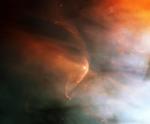 LL Orionis: When Cosmic Winds Collide
15.11.2003
This arcing, graceful structure is actually a bow shock about half a light-year across, created as the wind from young star LL Orionis collides with the Orion Nebula flow. Adrift in Orion's stellar...
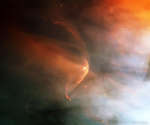 LL Orionis: When Cosmic Winds Collide
22.05.2016
What created this great arc in space? This arcing, graceful structure is actually a bow shock about half a light-year across, created as the wind from young star LL Orionis collides with the Orion Nebula flow.
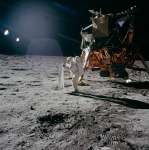 APOD: 2026 September 12 Б Apollo 11: Catching Some Sun
12.09.2026
Bright sunlight glints as long dark shadows mark this image of the surface of the Moon. It was taken on July 20, 1969, by Apollo 11 astronaut Neil Armstrong, the first to walk on the lunar surface. Pictured is the mission's lunar module, the Eagle, and spacesuited lunar module pilot Buzz Aldrin.
 Superbubbles in the LMC
3.07.1996
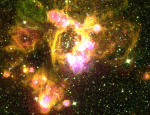
Why is there a hole in the center of this nebula? A leading explanation is that it is caused by the stellar winds from the stars that live there. Stars - including the Sun - expel electrons, protons, and other charged ions in a steady stream - the stellar wind.
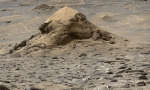 APOD: 2026 July 21 Б Turtle Rock on Mars
21.07.2026
Is this a fossilized turtle on Mars? No. Although resembling a large Earth tortoise, this is a layered rock outcrop on Mars that is estimated to span about 15 meters, making it much larger than turtles on Earth.
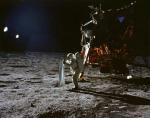 Apollo 11: Catching Some Sun
27.07.2002
Bright sunlight glints and long dark shadows dramatize this image of the lunar surface taken by Apollo 11 astronaut Neil Armstrong, the first to walk on the Moon. Pictured is the mission's lunar...
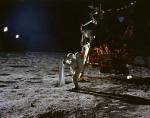 Apollo 11: Catching Some Sun
20.09.2003
Bright sunlight glints and long dark shadows dramatize this image of the lunar surface taken by Apollo 11 astronaut Neil Armstrong, the first to walk on the Moon. Pictured is the mission's lunar...
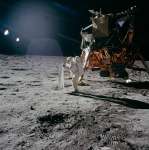 Apollo 11: Catching Some Sun
22.07.2017
Bright sunlight glints and long dark shadows mark this image of the lunar surface. It was taken July 20, 1969 by Apollo 11 astronaut Neil Armstrong, the first to walk on the Moon. Pictured...
|
January February March April May June July August September |
|||||||||||||||||||||||||||||||||||||||||||||||||