
|
You entered: wind
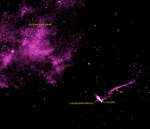 The Long Jet of the Lighthouse Nebula
21.02.2014
The Lighthouse nebula was formed by the wind of a pulsar, a rapidly rotating, magnetized neutron star, as it speeds through the interstellar medium at over 1,000 kilometers per second. Some...
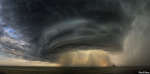 A Supercell Thunderstorm Cloud Over Montana
25.02.2017
Is that a spaceship or a cloud? Although it may seem like an alien mothership, it's actually a impressive thunderstorm cloud called a supercell. Such colossal storm systems center on mesocyclones -- rotating updrafts that can span several kilometers and deliver torrential rain and high winds including tornadoes.
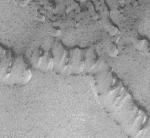 The Dunes Of Mars
14.08.1998
The North Pole of Mars is ringed by a "sea of sand dunes". For Mars' Northern Hemisphere, Spring began in mid July and increased sunlight is now shrinking the polar cap revealing the wind-swept dunes to the cameras onboard the Mars Global Surveyor spacecraft.
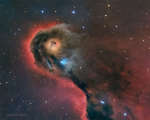 APOD: 2025 October 14 Б An Unusual Globule in IC 1396
13.10.2025
Is there a monster in IC 1396? Known to some as the Elephant's Trunk Nebula, parts of gas and dust clouds of this star formation region may appear to take on foreboding forms, some nearly human. The only real monster here, however, is a bright young star too far from Earth to hurt us.
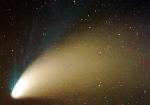 Hale-Bopp's Fickle Ion Tail
14.05.1997
What's happening to Comet Hale-Bopp's blue ion tail? The comet's ion tail is fluctuating more rapidly as it passes a region of changing solar wind. As the comet passes from north to south, it crosses the plane of the Sun's equator, where the solar magnetic field changes direction.
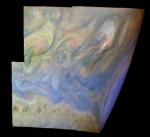 West Of The Great Red Spot
25.12.1997
The turbulent region West of Jupiter's Great Red Spot is highlighted in this recent picture constructed from data recorded by the Galileo spacecraft. The image is color coded to show cloud height and thickness; white clouds are high and thick, light blue clouds are high and thin, and reddish clouds are low.
 BZ Cam Bow Shock
27.11.2000
BZ Cam is a binary star system that is not well understood. In most cataclysmic variables, matter from a normal star accumulates on the surface of the companion white dwarf star, eventually causing a nova-like flare as the material becomes hot enough to ignite nuclear fusion.
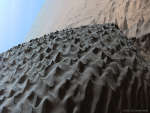 Dark Dunes on Mars
19.07.2016
How does wind affect sand on Mars? To help find out if it differs significantly from Earth, the robotic Curiosity rover on Mars was directed to investigate the dark Namib Dune in the Bagnold Dune Field in Gale Crater. Namib is the first active sand dune investigated up close outside of planet Earth.
 NGC 2244: A Star Cluster in the Rosette Nebula
16.03.2002
In the heart of the Rosette Nebula lies a bright open cluster of stars that lights up the nebula. The stars of NGC 2244 formed from the surrounding gas only four million years ago and emit light and wind that define the nebula's appearance today.
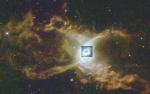 The Red Spider Planetary Nebula
5.01.1998
Oh what a tangled web a planetary nebula can weave. The Red Spider Planetary Nebula shows the complex structure that can result when a normal star ejects its outer gases and becomes a white dwarf star.
|
January February March April May June July August September |
|||||||||||||||||||||||||||||||||||||||||||||||||