
|
You entered: wind
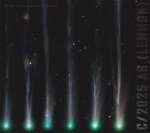 APOD: 2025 October 6 Б The Changing Ion Tail of Comet Lemmon
5.10.2025
How does a comet tail change? It depends on the comet. The ion tail of Comet C/2025 A6 (Lemmon) has been changing markedly, as detailed in the featured image sequenced over six days between September 25 and October 4 (left to right) from Texas, USA.
 Apollo 11: Catching Some Sun
28.07.2023
Bright sunlight glints as long dark shadows mark this image of the surface of the Moon. It was taken fifty-four years ago, July 20, 1969, by Apollo 11 astronaut Neil Armstrong, the first to walk on the lunar surface. Pictured is the mission's lunar module, the Eagle, and spacesuited lunar module pilot Buzz Aldrin.
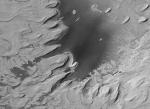 Ancient Layered Rocks on Mars
26.11.2001
Is this a picture of Mars or Earth? Oddly enough, it is a picture of Mars. What may appear to some as a terrestrial coastline is in fact a formation of ancient layered rocks and wind-blown sand on Mars. The above-pictured region spans about three kilometers in Schiaparelli Crater.
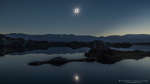 A Total Solar Eclipse Reflected
4.08.2019
If you saw a total solar eclipse, would you do a double-take? One astrophotographer did just that -- but it took a lake and a bit of planning. Realizing that the eclipse would...
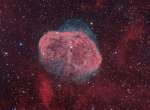 NGC 6888: The Crescent Nebula
13.08.2008
NGC 6888, also known as the Crescent Nebula, is a cosmic bubble about 25 light-years across, blown by winds from its central, bright, massive star. This beautiful telescopic view combines a composite color image with narrow band data that isolates light from hydrogen and oxygen atoms in the wind-blown nebula.
 A Wolf-Rayet Star Blows Bubbles
2.01.1997
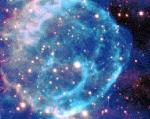
Wolf-Rayet stars can blow bubbles. These unusual stars are much hotter and more luminous than our Sun. All extremely massive stars will eventually evolve though a Wolf-Rayet phase. Approximately 200 Wolf-Rayet stars are known in our Milky Way Galaxy. Wolf-Rayet stars generate bubbles because they continually eject their outer atmosphere as a stellar wind.
 NGC 6888: The Crescent Nebula
9.06.2016
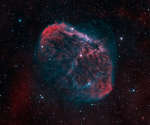
NGC 6888, also known as the Crescent Nebula, is a cosmic bubble about 25 light-years across, blown by winds from its central, bright, massive star. This sharp telescopic portrait uses narrow band image data that isolates light from hydrogen and oxygen atoms in the wind-blown nebula.
 Almost Three Tails for Comet Encke
19.02.2017
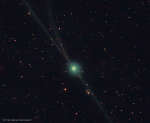
How can a comet have three tails? Normally, a comet has two tails: an ion tail of charged particles emitted by the comet and pushed out by the wind from...
 Voyager at 90 AU
19.11.2003
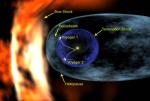
Launched in 1977, Voyager 1 is now about 12 light-hours or 90 astronomical units (AU) from the Sun, making this spacecraft humanity's most distant ambassador to the cosmos. Well beyond the orbits...
 Aurora in the Night
30.10.2002
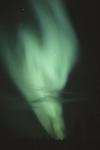
For much of the month of October, traveling shock waves from the Sun and solar wind gusts have buffeted planet Earth's magnetosphere. As a result, skywatchers at high latitudes in the northern hemisphere were treated to many displays of the aurora borealis or northern lights.
|
January February March April May June July August September |
|||||||||||||||||||||||||||||||||||||||||||||||||