
|
You entered: universe
 APOD: 2025 May 27 Б Zeta and Rho Ophiuchi with Milky Way
27.05.2025
Behold one of the most photogenic regions of the night sky, captured impressively. Featured, the band of our Milky Way Galaxy runs diagonally along the bottom-left corner, while the colorful Rho Ophiuchi cloud complex is visible just right of center and the large red circular Zeta Ophiuchi Nebula appears near the top.
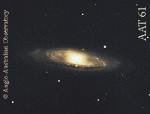 Leo Triplet Spiral Galaxy M65
12.08.1996
Spiral galaxy M65 is a normal spiral galaxy not unlike our own Milky Way. In fact, M65 is a typical spiral galaxy of a type that could be found anywhere in the local universe. Given a morphological type of "Sa", M65 shows tightly wrapped spiral arms and a large nuclear central bulge.
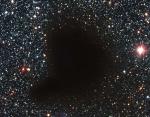 Molecular Cloud Barnard 68
2.02.2003
Where did all the stars go? What used to be considered a hole in the sky is now known to astronomers as a dark molecular cloud. Here, a high concentration of dust and molecular gas absorb practically all the visible light emitted from background stars.
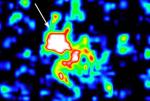 A GRB Host?
25.06.1997
Where do gamma-ray bursts (GRBs) originate? The most powerful explosions in the universe have recently been located with record accuracy. But do GRBs occur in galaxies or out alone in deep space? This picture taken with the Hubble Space Telescope of the field surrounding GRB 970228 might provide a clue.
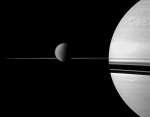 Titan, Rings, and Saturn from Cassini
8.03.2011
How thin are the rings of Saturn? Saturn's rings to be about one kilometer thick, making them many times thinner, in relative proportion, than a razor blade. This thinness sometimes appears in dramatic fashion during an image taken nearly along the ring plane.
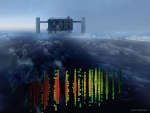 Distant Neutrinos Detected Below Antarctic Ice
1.09.2015
From where do these neutrinos come? The IceCube Neutrino Observatory near the South Pole of the Earth has begun to detect nearly invisible particles of very high energy. Although these rarely-interacting neutrinos pass through much of the Earth just before being detected, where they started remains a mystery.
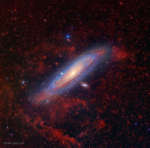 Clouds of Andromeda
8.01.2018
What are those red clouds surrounding the Andromeda galaxy? This galaxy, M31, is often imaged by planet Earth-based astronomers. As the nearest large spiral galaxy, it is a familiar sight with dark dust lanes, bright yellowish core, and spiral arms traced by clouds of bright blue stars.
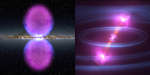 Fermi Science Finals
23.07.2018
The Fermi Science Playoffs celebrate 10 years of the Fermi Gamma-ray Space Telescope's exploration of the high-energy universe. Surviving all early rounds of voting, these two finalists in the competion square off at last.
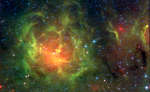 Spitzer s Trifid
13.02.2020
The Trifid Nebula, also known as Messier 20, is easy to find with a small telescope. About 30 light-years across and 5,500 light-years distant it's a popular stop for cosmic tourists in the nebula rich constellation Sagittarius.
 Unraveling NGC 3169
2.03.2023
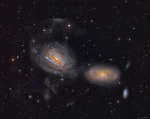
Spiral galaxy NGC 3169 looks to be unraveling like a ball of cosmic yarn. It lies some 70 million light-years away, south of bright star Regulus toward the faint constellation Sextans. Wound up spiral arms are pulled out into sweeping tidal tails as NGC 3169 (left) and neighboring NGC 3166 interact gravitationally.
|
January February March April May |
|||||||||||||||||||||||||||||||||||||||||||||||||