
|
You entered: universe
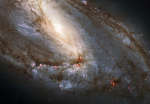 Messier 66 Close Up
13.06.2024
Big, beautiful spiral galaxy Messier 66 lies a mere 35 million light-years away. The gorgeous island universe is about 100 thousand light-years across, similar in size to the Milky Way. This Hubble Space Telescope close-up view spans a region about 30,000 light-years wide around the galactic core.
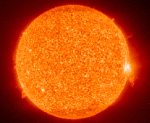 Helios Helium
20.05.1996
Above is an image of the relatively quiet Sun made on May 18 in light emitted by ionized Helium atoms in the Solar chromosphere. Helium was first discovered in the Sun in 1868, its name fittingly derived from from the Greek word Helios, meaning Sun. Credit for the discovery goes to astronomer Joseph Lockyer.
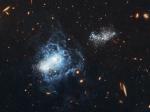 I Zwicky 18: The Case of the Aging Galaxy
17.10.2007
How old is this galaxy? The galaxy on the left, I Zwicky 18, was once thought to be one of the youngest galaxies on record since its bright stars indicated an age of only 500 million years.
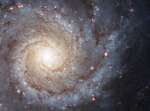 M74: The Perfect Spiral
1.12.2007
If not perfect, then this spiral galaxy is at least one of the most photogenic. An island universe of about 100 billion stars, 32 million light-years away toward the constellation Pisces, M74 presents a gorgeous face-on view.
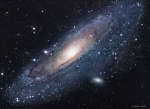 M31: The Andromeda Galaxy
30.08.2015
What is the nearest major galaxy to our own Milky Way Galaxy? Andromeda. In fact, our Galaxy is thought to look much like Andromeda. Together these two galaxies dominate the Local Group of galaxies. The diffuse light from Andromeda is caused by the hundreds of billions of stars that compose it.
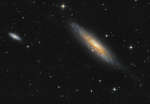 Sculptor Galaxy NGC 134
4.03.2016
NGC 134 is probably not the best known spiral galaxy in the constellation Sculptor. Still, the tantalizing island universe is a clearly a telescopic treasure in southern skies. It shares a bright core, clumpy...
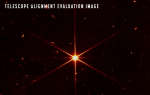 2MASS J17554042 6551277
19.03.2022
2MASS J17554042+6551277 doesn't exactly roll off the tongue but that's the name, a coordinate-based catalog designation, of the star centered in this sharp field of view. Fans of the distant universe should get used to its spiky appearance though.
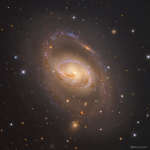 Messier 96
14.04.2022
Spiral arms seem to swirl around the core of Messier 96 in this colorful, detailed portrait of a beautiful island universe. Of course M96 is a spiral galaxy, and counting the faint arms extending beyond the brighter central region it spans 100 thousand light-years or so.
 APOD: 2023 January 8 Б Where Your Elements Came From
8.01.2023
The hydrogen in your body, present in every molecule of water, came from the Big Bang. There are no other appreciable sources of hydrogen in the universe. The carbon in your body was made by nuclear fusion in the interior of stars, as was the oxygen.
 APOD: 2025 April 9 Б HH 49: Interstellar Jet from Webb
9.04.2025
What's at the tip of this interstellar jet? First let's consider the jet: it is being expelled by a star system just forming and is cataloged as Herbig-Haro 49 (HH 49). The star system expelling this jet is not visible -- it is off to the lower right.
|
January February March April May |
|||||||||||||||||||||||||||||||||||||||||||||||||