
|
You entered: universe
 Unraveling NGC 3169
23.05.2024
Spiral galaxy NGC 3169 looks to be unraveling like a ball of cosmic yarn. It lies some 70 million light-years away, south of bright star Regulus toward the faint constellation Sextans. Wound up spiral arms are pulled out into sweeping tidal tails as NGC 3169 (left) and neighboring NGC 3166 interact gravitationally.
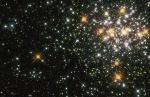 NGC 1818: A Young Globular Cluster
7.03.1998
Globular clusters once ruled the Milky Way. Back in the old days, back when our Galaxy first formed, perhaps thousands of globular clusters roamed our Galaxy. Today, there are perhaps 200 left. Many globular clusters were destroyed over the eons by repeated fateful encounters with each other or the Galactic center.
 April Fools Day More Intense On Mars
1.04.2004
Today, April 1st, astrophysicists have announced a surprising discovery - April Fools Day is more intense on Mars! Though the discovery is contrary to accepted theories of April Fools Day, researchers note that there are several likely causes for the severe martian April Fools phenomenon.
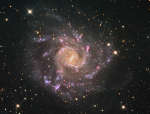 Grand Spiral Galaxy NGC 7424
8.01.2013
The grand, winding arms are almost mesmerizing in this face-on view of NGC 7424, a spiral galaxy with a prominent central bar. About 40 million light-years distant in the headlong constellation Grus, this island universe is also about 100,000 light-years across making it remarkably similar to our own Milky Way.
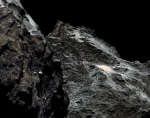 62 Kilometers above Comet Churyumov Gerasimenko
15.09.2014
Spacecraft Rosetta continues to approach, circle, and map Comet Churyumov-Gerasimenko. Crossing the inner Solar System for ten years to reach the vicinity of the comet last month, the robotic spacecraft continues to image the unusual double-lobed comet nucleus. The reconstructed-color image featured, taken about 10 days ago, indicates how dark this comet nucleus is.
 Galaxies Of The Virgo Cluster
26.01.2001
Well over a thousand galaxies are known members of the Virgo Cluster, the closest large cluster of galaxies to our own local group. The galaxy cluster is difficult to see all at once because it covers such a large area on the sky.
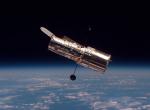 Hubble Floats Free
24.11.2002
Why put observatories in space? Most telescopes are on the ground. On the ground, you can deploy a heavier telescope and fix it more easily. The trouble is that Earth-bound telescopes must look through the Earth's atmosphere.
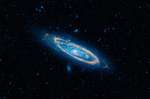 WISE Infrared Andromeda
19.02.2010
This sharp, wide-field view features infrared light from the spiral Andromeda Galaxy (M31). Dust heated by Andromeda's young stars is shown in yellow and red, while its older population of stars appears as a bluish haze. The false-color skyscape is a mosaic of images from NASA's new Wide-field Infrared Survey Explorer (WISE) satellite.
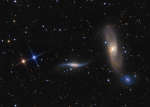 Arp 286: Trio in Virgo
13.08.2010
A remarkable telescopic composition in yellow and blue, this scene features a trio of interacting galaxies almost 90 million light-years away, toward the constellation Virgo. On the left, two, spiky, foreground Milky Way stars echo the trio galaxy hues, a reminder that stars in our own galaxy are like those in the distant island universes.
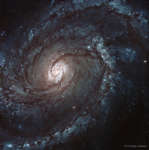 M100: A Grand Design Spiral Galaxy
10.02.2015
Majestic on a truly cosmic scale, M100 is appropriately known as a grand design spiral galaxy. It is a large galaxy of over 100 billion stars with well-defined spiral arms that is similar to our own Milky Way Galaxy.
|
January February March April May |
|||||||||||||||||||||||||||||||||||||||||||||||||