
|
You entered: universe
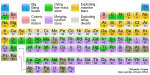 Where Your Elements Came From
24.10.2017
The hydrogen in your body, present in every molecule of water, came from the Big Bang. There are no other appreciable sources of hydrogen in the universe. The carbon in your body was made by nuclear fusion in the interior of stars, as was the oxygen.
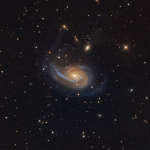 Arp 78: Peculiar Galaxy in Aries
18.09.2020
(xxxedit and linkxxx) Peculiar spiral galaxy Arp 78 is found within the boundaries of the head strong constellation Aries, some 100 million light-years beyond the stars and nebulae of our Milky Way galaxy. Also...
 NGC 6995: The Bat Nebula
27.10.2021
Do you see the bat? It haunts this cosmic close-up of the eastern Veil Nebula. The Veil Nebula itself is a large supernova remnant, the expanding debris cloud from the death explosion of a massive star.
 APOD: 2024 November 17 Б LDN 1471: A Windblown Star Cavity
17.11.2024
What is the cause of this unusual parabolic structure? This illuminated cavity, known as LDN 1471, was created by a newly forming star, seen as the bright source at the peak of the parabola.
 APOD: 2025 July 30 Б Coronal Loops on the Sun
30.07.2025
Our Sun frequently erupts in loops. Hot solar plasma jumps off the Sun's surface into prominences, with the most common type of prominence being a simple loop. The loop shape originates from the Sun's magnetic field, which is traced by spiraling electrons and protons.
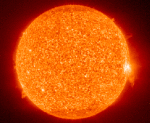 Helios Helium
16.05.1998
This image of the relatively quiet Sun was made using ultraviolet light emitted by ionized Helium atoms in the Solar chromosphere. Helium was first discovered in the Sun in 1868, its name fittingly derived from from the Greek word Helios, meaning Sun.
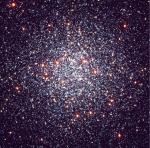 M55: Globular Star Cluster
18.09.2004
The fifty-fifth entry in Charles Messier's catalog, M55 is a large and lovely globular cluster of around 100,000 stars. Only 20,000 light-years away in the constellation Sagittarius, M55 appears to earth-bound observers to be nearly 2/3 the size of the full moon.
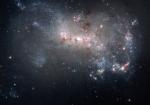 NGC 4449: Close Up of a Small Galaxy
10.07.2007
Grand spiral galaxies often seem to get all the glory. Their newly formed, bright, blue star clusters along beautiful, symmetric spiral arms are guaranteed to attract attention. But small irregular galaxies form stars too, like NGC 4449, located about 12 million light-years away.
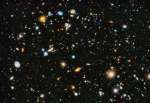 Hubble Ultra Deep Field 2014
5.06.2014
Galaxies like colorful pieces of candy fill the Hubble Ultra Deep Field 2014. The dimmest galaxies are more than 10 billion times fainter than stars visible to the unaided eye and represent the Universe in the extreme past, a few 100 million years after the Big Bang.
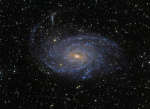 Spiral Galaxy NGC 6744
10.08.2018
Beautiful spiral galaxy NGC 6744 is nearly 175,000 light-years across, larger than our own Milky Way. It lies some 30 million light-years distant in the southern constellation Pavo and appears as only a faint, extended object in small telescopes. We see the disk of the nearby island universe tilted towards our line of sight.
|
January February March April May |
|||||||||||||||||||||||||||||||||||||||||||||||||