
|
You entered: gas
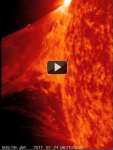 A Solar Prominence Eruption from SDO
7.03.2011
One of the most spectacular solar sights is an erupting prominence. Two weeks ago, NASA's Sun-orbiting Solar Dynamic Observatory spacecraft imaged an impressively large prominence erupting from the surface. The dramatic explosion...
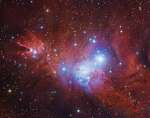 In the Vicinity of the Cone Nebula
6.08.2013
Strange shapes and textures can be found in neighborhood of the Cone Nebula. The unusual shapes originate from fine interstellar dust reacting in complex ways with the energetic light and hot gas being expelled by the young stars.
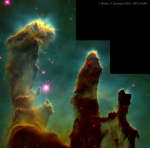 M16: Pillars of Star Creation
24.04.2016
Newborn stars are forming in the Eagle Nebula. This image, taken with the Hubble Space Telescope in 1995, shows evaporating gaseous globules (EGGs) emerging from pillars of molecular hydrogen gas and dust. The giant pillars are light years in length and are so dense that interior gas contracts gravitationally to form stars.
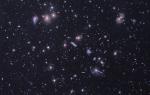 The Hercules Cluster of Galaxies
19.07.2007
These are galaxies of the Hercules Cluster, an archipelago of island universes a mere 500 million light-years away. Also known as Abell 2151, this cluster is loaded with gas and dust rich, star-forming spiral galaxies but has relatively few elliptical galaxies, which lack gas and dust and the associated newborn stars.
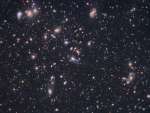 The Hercules Cluster of Galaxies
16.07.2009
These are galaxies of the Hercules Cluster, an archipelago of island universes a mere 500 million light-years away. Also known as Abell 2151, this cluster is loaded with gas and dust rich, star-forming spiral galaxies but has relatively few elliptical galaxies, which lack gas and dust and the associated newborn stars.
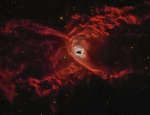 The Red Spider Planetary Nebula
29.10.2012
Oh what a tangled web a planetary nebula can weave. The Red Spider Planetary Nebula shows the complex structure that can result when a normal star ejects its outer gases and becomes a white dwarf star.
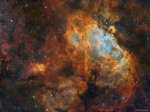 M16: In and Around the Eagle Nebula
15.10.2018
From afar, the whole thing looks like an Eagle. A closer look at the Eagle Nebula, however, shows the bright region is actually a window into the center of a larger dark shell of dust. Through this window, a brightly-lit workshop appears where a whole open cluster of stars is being formed.
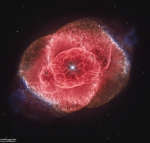 In the Center of the Cats Eye Nebula
10.07.2022
Three thousand light-years away, a dying star throws off shells of glowing gas. This image from the Hubble Space Telescope reveals the Cat's Eye Nebula (NGC 6543), to be one of the most complex planetary nebulae known.
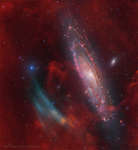 APOD: 2023 January 17 Б Unexpected Clouds Toward the Andromeda Galaxy
17.01.2023
Why are there oxygen-emitting arcs near the direction of the Andromeda galaxy? No one is sure. The gas arcs, shown in blue, were discovered and first confirmed by amateur astronomers just last year.
 APOD: 2025 September 8 Б IRAS 04302: Butterfly Disk Planet Formation
8.09.2025
This butterfly can hatch planets. The nebula fanning out from the star IRAS 04302+2247 may look like the wings of a butterfly, while the vertical brown stripe down the center may look like the butterfly's body -- but together they indicate an active planet-forming system.
|
January February March April May |
|||||||||||||||||||||||||||||||||||||||||||||||||