
|
You entered: gas
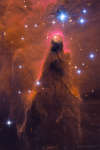 APOD: 2023 January 10 Б NGC 2264: The Cone Nebula
10.01.2023
Stars are forming in the gigantic dust pillar called the Cone Nebula. Cones, pillars, and majestic flowing shapes abound in stellar nurseries where clouds of gas and dust are sculpted by energetic winds from newborn stars. The Cone Nebula, a well-known example, lies within the bright galactic star-forming region NGC 2264.
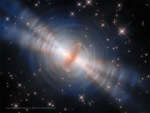 APOD: 2026 February 25 Б The Egg Nebula from the Hubble Telescope
25.02.2026
Ever wonder what it would look like to crack open the Sun? The Egg Nebula, a dying Sun-like star, can unscramble this question. Pictured is a combination of several visible and infrared images of the nebula (also known as RAFGL 2688 or CRL 2688) taken with the Hubble Space Telescope.
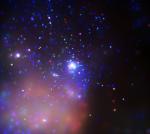 X Ray Portrait of Trumpler 14
2.09.2005
A wonder of planet Earth's southern sky, star cluster Trumpler 14 lies about nine thousand light-years away in the Carina complex -- a rich star forming region at the edge of a giant molecular cloud.
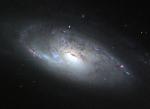 M106: A Spiral Galaxy with a Strange Core
15.02.2000
What's happening at the center of spiral galaxy M106? A swirling disk of stars and gas, M106's appearance is dominated by two bright spiral arms and dark dust lanes near the nucleus. Bright newly formed stars near their outer tips distinguish the spiral arms in the above photograph.
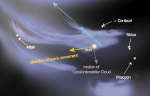 The Local Fluff
29.08.2010
The stars are not alone. In the disk of our Milky Way Galaxy about 10 percent of visible matter is in the form of gas, called the interstellar medium (ISM). The ISM is not uniform, and shows patchiness even near our Sun.
 APOD: 2023 May 15 Б M16: Eagle Nebula Deep Field
15.05.2023
From afar, the whole thing looks like an eagle. A closer look at the Eagle Nebula, however, shows the bright region is actually a window into the center of a larger dark shell of dust. Through this window, a brightly-lit workshop appears where a whole open cluster of stars is being formed.
 APOD: 2023 September 19 Б HH 211: Jets from a Forming Star
19.09.2023
Do stars always create jets as they form? No one is sure. As a gas cloud gravitationally contracts, it forms a disk that can spin too fast to continue contracting into a protostar. Theorists hypothesize that this spin can be reduced by expelling jets.
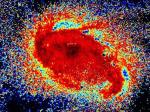 Comet-like Clouds in the Cartwheel Galaxy
28.11.1996
In a cartwheel-shaped galaxy far, far away, huge comet-shaped clouds of gas have been discovered racing through the nucleus at about 700,000 miles per hour. The aptly named Cartwheel Galaxy is actually about 500 million light years distant, its suggestive shape created by a head-on collision with a smaller galaxy.
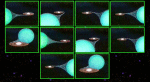 Black Hole Signature From Advective Disks
15.01.1997
What does a black hole look like? If alone, a black hole would indeed appear quite black, but many black hole candidates are part of binary star systems. So how does a black hole binary system look different from a neutron star binary system? The above drawings indicate it is difficult to tell!
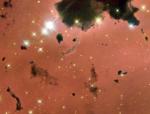 Thackerays Globules
16.08.2003
Rich star fields and glowing hydrogen gas silhouette dense, opaque clouds of interstellar gas and dust in this Hubble Space Telescope close-up of IC 2944, a bright star forming region in Centaurus, 5,900 light-years away. The largest of these dark globules, first spotted by South African astronomer A. D.
|
January February March April May |
|||||||||||||||||||||||||||||||||||||||||||||||||