
|
You entered: gas
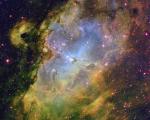 Inside the Eagle Nebula
21.09.2003
From afar, the whole thing looks like an Eagle. A closer look of the Eagle Nebula, however, shows the bright region is actually a window into the center of a larger dark shell of dust. Through this window, a brightly-lit workshop appears where a whole open cluster of stars is being formed.
 Tentacles of the Tarantula Nebula
28.12.2004
The Tarantula Nebula is a giant emission nebula within our neighboring galaxy the Large Magellanic Cloud. Inside this cosmic arachnid lies a huge central young cluster of massive stars, cataloged as R136 and partially visible on the upper right.
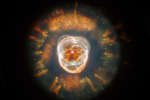 The Eskimo Nebula from Hubble
3.05.2009
In 1787, astronomer William Herschel discovered the Eskimo Nebula. From the ground, NGC 2392 resembles a person's head surrounded by a parka hood. In 2000, the Hubble Space Telescope imaged the Eskimo Nebula. From space, the nebula displays gas clouds so complex they are not fully understood.
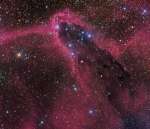 The Dark Tower in Scorpius
6.01.2013
In silhouette against a crowded star field toward the constellation Scorpius, this dusty cosmic cloud evokes for some the image of an ominous dark tower. In fact, clumps of dust and molecular gas collapsing...
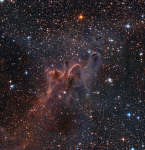 Cometary Globules
12.10.2013
Bright-rimmed, flowing shapes gather near the center of this rich starfield toward the boarders of the nautical southern constellations Pupis and Vela. Composed of interstellar gas and dust, the grouping of light-year sized cometary globules is about 1300 light-years distant.
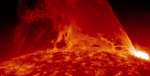 A Solar Prominence Eruption from SDO
26.05.2019
One of the most spectacular solar sights is an erupting prominence. In 2011, NASA's Sun-orbiting Solar Dynamic Observatory spacecraft imaged an impressively large prominence erupting from the surface. The dramatic explosion was captured in ultraviolet light in the featured time lapse video covering 90 minutes, where a new frame was taken every 24 seconds.
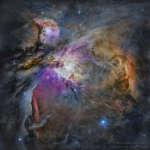 Orion Nebula: The Hubble View
29.06.2021
Few cosmic vistas excite the imagination like the Orion Nebula. Also known as M42, the nebula's glowing gas surrounds hot young stars at the edge of an immense interstellar molecular cloud only 1,500 light-years away.
 Jupiter over 2 Hours and 30 Minutes
19.01.2024
Jupiter, our Solar System's ruling gas giant, is also the fastest spinning planet, rotating once in less than 10 hours. The gas giant doesn't rotate like a solid body though.
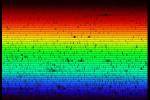 The Solar Spectrum
15.08.2000
It is still not known why the Sun's light is missing some colors. Shown above are all the visible colors of the Sun, produced by passing the Sun's light through a prism-like device.
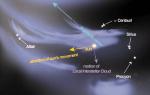 The Local Interstellar Cloud
10.02.2002
The stars are not alone. In the disk of our Milky Way Galaxy about 10 percent of visible matter is in the form of gas, called the interstellar medium (ISM). The ISM is not uniform, and shows patchiness even near our Sun.
|
January February March April May |
|||||||||||||||||||||||||||||||||||||||||||||||||