
|
You entered: gas
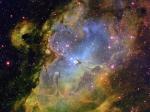 Inside the Eagle Nebula
26.02.2006
From afar, the whole thing looks like an Eagle. A closer look at the Eagle Nebula, however, shows the bright region is actually a window into the center of a larger dark shell of dust. Through this window, a brightly-lit workshop appears where a whole open cluster of stars is being formed.
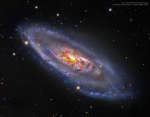 M106: A Spiral Galaxy with a Strange Center
15.02.2015
What's happening at the center of spiral galaxy M106? A swirling disk of stars and gas, M106's appearance is dominated by blue spiral arms and red dust lanes near the nucleus, as shown in the featured image.
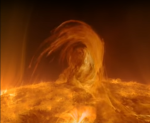 Sun Dance
10.10.2018
Sometimes, the surface of our Sun seems to dance. In the middle of 2012, for example, NASA's Sun-orbiting Solar Dynamic Observatory spacecraft imaged an impressive prominence that seemed to perform a running dive roll like an acrobatic dancer.
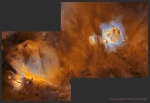 Horsehead and Orion Nebulas
18.03.2019
The dark Horsehead Nebula and the glowing Orion Nebula are contrasting cosmic vistas. Adrift 1,500 light-years away in one of the night sky's most recognizable constellations, they appear in opposite corners of the above stunning two-panel mosaic.
 Galaxy Wars: M81 and M82
15.05.2020
These two galaxies are far far away, 12 million light-years distant toward the northern constellation of the Great Bear. On the left, with grand spiral arms and bright yellow core is spiral galaxy M81, some 100,000 light-years across. On the right marked by red gas and dust clouds, is irregular galaxy M82.
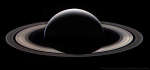 Saturn at Night
26.11.2022
Saturn is still bright in planet Earth's night skies. Telescopic views of the distant gas giant and its beautiful rings often make it a star at star parties. But this stunning view of Saturn's rings and night side just isn't possible from telescopes closer to the Sun than the outer planet.
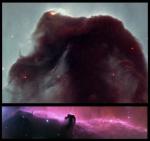 Horsehead Rides Again
26.04.2001
Difficult to see in small telescopes, the Horsehead nebula was recently selected by internet voters as a target for the Hubble Space Telescope. Above (top) is Hubble's detailed view of the dark cosmic dust cloud, released to celebrate the 11th anniversary of the workhorse orbiting observatory.
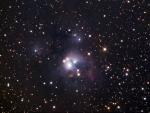 Young Suns of NGC 7129
11.08.2005
Young suns still lie within dusty NGC 7129, some 3,000 light-years away toward the royal constellation Cepheus. While these stars are at a relatively tender age, only about a million years old, it is likely that our own Sun formed in a similar stellar nursery some five billion years ago.
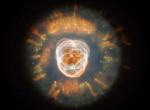 The Eskimo Nebula from the Newly Fixed Hubble
24.01.2000
In 1787, astronomer William Herschel discovered the Eskimo Nebula. From the ground, NGC 2392 resembles a person's head surrounded by a parka hood. In 2000, just after being fixed, the Hubble Space Telescope imaged the Eskimo Nebula. From space, the nebula displays gas clouds so complex they are not fully understood.
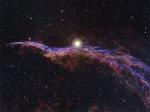 NGC 6960: The Witch's Broom Nebula
1.01.2007
Ten thousand years ago, before the dawn of recorded human history, a new light must suddenly have appeared in the night sky and faded after a few weeks. Today we know this light was an exploding star and record the colorful expanding cloud as the Veil Nebula.
|
January February March April May |
|||||||||||||||||||||||||||||||||||||||||||||||||