
|
You entered: orbit
 Three Worlds for TRAPPIST 1
7.05.2016
Three new found worlds orbit the ultracool dwarf star TRAPPIST-1, a mere 40 light-years away. Their transits were first detected by the Belgian robotic TRAnsiting Planets and Planetesimals Small Telescope, TRAPPIST, at ESO's La Silla Observatory in Chile. The newly discovered exoplanets are all similar in size to Earth.
 Tardigrade in Moss
26.03.2017
Is this an alien? Probably not, but of all the animals on Earth, the tardigrade might be the best candidate. That's because tardigrades are known to be able to go for decades without...
 Cassini to Venus
3.07.2004
Saturn Orbiter Cassini with Titan Probe Huygens attached rocketed into early morning skies on October 15, 1997. The mighty Titan 4B Centaur rocket is seen here across the water, arcing away from Launch Complex 40 at Cape Canaveral Air Station.
 Dry Ice Sled Streaks on Mars
17.06.2013
What creates these long and nearly straight grooves on Mars? Dubbed linear gullies, they appear on the sides of some sandy slopes during Martian spring, have nearly constant width, extend for as long as two kilometers, and have raised banks along their sides.
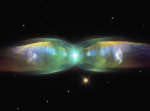 M2 9: Wings of a Butterfly Nebula
13.09.2020
Are stars better appreciated for their art after they die? Actually, stars usually create their most artistic displays as they die. In the case of low-mass stars like our Sun and M2-9 pictured here, the stars transform themselves from normal stars to white dwarfs by casting off their outer gaseous envelopes.
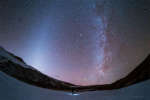 Dueling Bands in the Night
1.03.2022
What are these two bands in the sky? The more commonly seen band is the one on the right and is the central band of our Milky Way galaxy. Our Sun orbits...
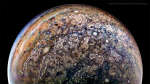 APOD: 2026 January 6 Б Jupiters Clouds in High Definition from Juno
6.01.2026
How complex is Jupiter? NASA's Juno mission to Jupiter is finding the Jovian giant to be more complicated than expected. Jupiter's magnetic field has been discovered to be much different from our Earth's simple dipole field, showing several poles embedded in a complicated network more convoluted in the north than the south.
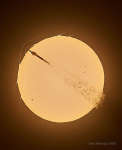 APOD: 2026 June 15 Б Triple Shockwave from Sun Crossing Rocket
15.06.2026
What's happening to this Sun-crossing rocket? The SpaceX Falcon 9 rocket, visible on the upper left, launched only about one minute before this amazing image was captured. As it rose to low Earth...
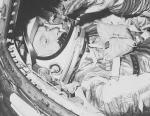 John Glenn: Friendship 7 To Discovery
29.10.1998
Rehearsing for his historic flight on February 20, 1962, Mercury program astronaut John H. Glenn Jr. works in a cramped training capsule preparing for a few hours' voyage through space. Dubbed Friendship...
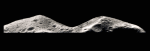 NEAR to an Asteroid
15.02.1996
Excitement mounts as NASA's Near Earth Asteroid Rendezvous (NEAR) spacecraft nears launch - currently scheduled for 3:53 ET on February 16. NEAR's mission is to become the first spacecraft to rendezvous with and orbit an asteroid, the asteroid designated 433 Eros.
|
January February March April May June July August September |
|||||||||||||||||||||||||||||||||||||||||||||||||