
|
You entered: orbit
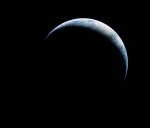 Apollo 17: The Crescent Earth
29.04.2021
Our fair planet sports a curved, sunlit crescent against the black backdrop of space in this stunning photograph. From the unfamiliar perspective, the Earth is small and, like a telescopic image of a distant planet, the entire horizon is completely within the field of view.
 Apollo 17 s Moonship
14.12.2024
Awkward and angular looking, Apollo 17's lunar module Challenger was designed for flight in the near vacuum of space. Digitally enhanced and reprocessed, this picture taken from Apollo 17's command module America shows Challenger's ascent stage in lunar orbit.
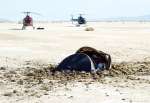 APOD: 2026 July 19 Б Flying Saucer Crash Lands in Utah Desert
19.07.2026
A flying saucer from outer space crash-landed in the Utah desert after being tracked by radar and chased by helicopters. The year was 2004, and no space aliens were involved. The saucer, pictured here...
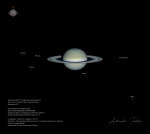 APOD: 2026 August 11 Б Six Moons of Saturn
11.08.2026
How many moons does Saturn have? While the total will likely continue to grow, as of June 2026 the ringed gas giant had 293 confirmed moons. That's easily more than any other planet of the Solar System, including ruling gas giant Jupiter with a mere 115 confirmed moons.
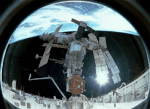 Mir is 10
10.03.1996
The first module of the Russian Space Agency's Mir Space Station was launched into orbit 10 years ago (on February 20, 1986). Mir has since been substantially expanded in orbit by adding additional modules including the Kvant Astrophysics Module (1987) and recently a docking module.
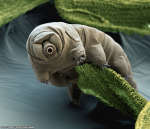 Tardigrade in Moss
6.03.2013
Is this an alien? Probably not, but of all the animals on Earth, the tardigrade might be the best candidate. That's because tardigrades are known to be able to go for decades without...
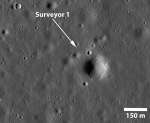 The Shadow of Surveyor 1
4.06.2016
Fifty years ago, Surveyor 1 reached the Moon. Launched on May 30, 1966 and landed on June 2, 1966 with the Moon at full phase it became the first US spacecraft to make a soft landing on another world.
 Welcome to Perihelion
4.01.2025
Earth's orbit around the Sun is not a circle, it's an ellipse. The point along its elliptical orbit where our fair planet is closest to the Sun is called perihelion. This year perihelion is today, January 4, at 13:28 UTC, with the Earth about 147 million kilometers from the Sun.
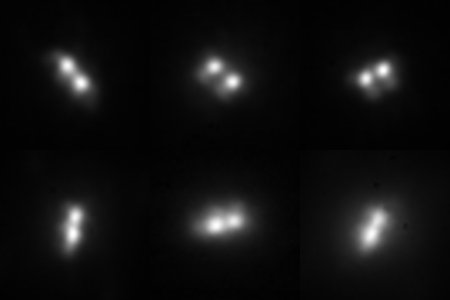 Double Asteroid 90 Antiope
1.11.2000
This eight-frame animation is based on the first ever images of a double asteroid! Formerly thought to be a single enormous chunk of rock, asteroid 90 Antiope resides in the solar system's main asteroid belt between Mars and Jupiter.
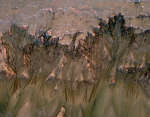 Seasonal Dark Streaks on Mars
8.08.2011
What is causing these dark streaks on Mars? A leading hypothesis is flowing -- but quickly evaporating -- water. The streaks, visible in dark brown near the image center, appear in the Martian spring and summer but fade in the winter months, only to reappear again the next summer.
|
January February March April May June July August September |
|||||||||||||||||||||||||||||||||||||||||||||||||