
|
You entered: orbit
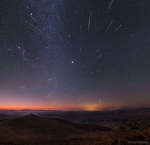 Geminid Meteors over Chile
8.12.2019
Are meteors streaming out from a point in the sky? Yes, in a way. When the Earth crosses a stream of Sun-orbiting meteors, these meteors appear to come from the direction of the stream -- with the directional point called the radiant.
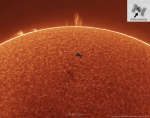 Space Station, Solar Prominences, Sun
4.05.2021
That's no sunspot. It's the International Space Station (ISS) caught passing in front of the Sun. Sunspots, individually, have a dark central umbra, a lighter surrounding penumbra, and no Dragon capsules attached.
 APOD: 2023 June 29 Б A Message from the Gravitational Universe
29.06.2023
Monitoring 68 pulsars with very large radio telescopes, the North American Nanohertz Observatory for Gravitational Waves (NANOGrav) has uncovered evidence for the gravitational wave (GW) background by carefully measuring slight shifts in the arrival times of pulses. These shifts are correlated between different pulsars in a way that indicates that they are caused by GWs.
 Vega and Comet 12P Pons-Brooks
8.12.2023
On December 4, periodic Comet 12P/Pons-Brooks shared this telescopic field of view with Vega, alpha star of the northern constellation Lyra. Fifth brightest star in planet Earth's night, Vega is some 25 light-years distant while the much fainter comet was about 21 light-minutes away.
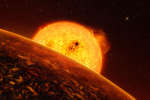 CoRoT Satellite Discovers Rocky Planet
23.09.2009
How similar is exoplanet CoRoT-7b to Earth? The newly discovered extra-solar planet is the closest physical match yet, with a mass about five Earths and a radius of about 1.7 Earths. Also, the home star to CoRoT-7b, although 500 light years distant, is very similar to our Sun.
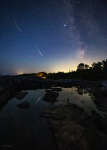 APOD: 2026 August 15 Б Bright Perseids from Sweden
15.08.2026
Known for its bright and fast meteors, the annual Perseid Meteor Shower comes to planet Earth's skies from a radiant in the heroic constellation Perseus. The popular northern summer celestial spectacle is created...
 Makemake of the Outer Solar System
16.07.2008
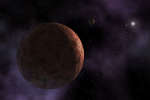
Recently discovered Makemake is one of the largest objects known in the outer Solar System. Pronounced MAH-kay MAH-kay, this Kuiper belt object is only slightly smaller than Pluto, orbits the Sun only slightly further out than Pluto, and appears only slightly dimmer than Pluto.
 Stickney Crater
8.07.2023
Stickney Crater, the largest crater on the martian moon Phobos, is named for Chloe Angeline Stickney Hall, mathematician and wife of astronomer Asaph Hall. Asaph Hall discovered both the Red Planet's moons in 1877.
 APOD: 2025 April 2 Б Jupiter and Ring in Infrared from Webb
2.04.2025
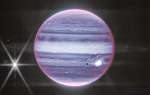
Why does Jupiter have rings? Jupiter's main ring was discovered in 1979 by NASA's passing Voyager 1 spacecraft, but its origin was then a mystery. Data from NASA's Galileo spacecraft that...
 Boston Moonrise
24.03.2011
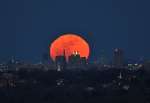
Last week's Full Moon was hard to miss. Rising on March 19, its exact full phase occurred within an hour of perigee, the closest point in the Moon's orbit to Earth.
|
January February March April May June July August September |
|||||||||||||||||||||||||||||||||||||||||||||||||