
|
You entered: orbit
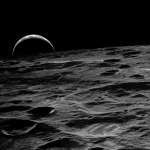 Apollo 14 Heads for Home
4.02.2021
Fifty years ago this Sunday (February 7, 1971), the crew of Apollo 14 left lunar orbit and headed for home. They watched this Earthrise from their command module Kittyhawk. With Earth's sunlit crescent just peeking over the lunar horizon, the cratered terrain in the foreground is along the lunar farside.
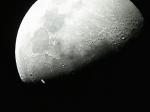 International Space Station in Transit
9.05.2003
A stunning telescopic image of the International Space Station crossing in front of an eight day old Moon, this picture was captured on April 11th. But while Wednesday's leisurely transit of Mercury across the Sun entertained observers all over the dayside of planet Earth, the audience for this lunar transit was more restricted.
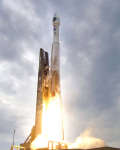 Atlas 5 Rocket Launches to the Moon
22.06.2009
This rocket is headed for the Moon. Pictured above, a huge Altas V rocket roared off the launch pad last week to start NASA's first missions to Earth's Moon in 10 years. The rocket is carrying two robotic spacecraft.
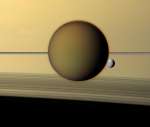 Ringside with Titan and Dione
5.01.2012
Orbiting in the plane of Saturn's rings, Saturnian moons have a perpetual ringside view of the gorgeous gas giant planet. Of course, while passing near the ring plane the Cassini spacecraft also shares their stunning perspective.
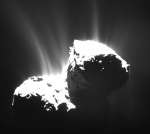 Jets from Comet Churyumov Gerasimenko
2.02.2015
Where do comet tails come from? Although it is common knowledge that comet tails and comas originate from comet nuclei, exactly how that happens is an active topic of research. One of the best...
 APOD: 2023 April 16 Б M2 9: Wings of a Butterfly Nebula
15.04.2023
Are stars better appreciated for their art after they die? Actually, stars usually create their most artistic displays as they die. In the case of low-mass stars like our Sun and M2-9 pictured here, the stars transform themselves from normal stars to white dwarfs by casting off their outer gaseous envelopes.
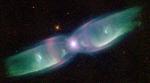 M2 9: Wings of a Butterfly Nebula
5.01.2002
Are stars better appreciated for their art after they die? Actually, stars usually create their most artistic displays as they die. In the case of low-mass stars like our Sun and M2-9 pictured above, the stars transform themselves from normal stars to white dwarfs by casting off their outer gaseous envelopes.
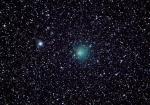 Comet Encke Returns
22.12.2003
It's back. Every 3.3 years, Comet Encke swoops back into our inner Solar System. First officially discovered in 1786, Comet Encke is on its 59 th documented return, making it one of the best-studied comets on the sky.
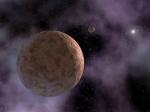 Sedna of the Outer Solar System
15.03.2004
What is the most distant known object in our Solar System? A new answer to this centuries-old question was announced yesterday by NASA with the discovery of a dark red object dubbed Sedna. Although over twice the distance to Pluto, Sedna is near its closest approach to the Sun.
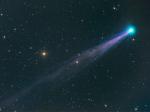 Comet SWAN Brightens
4.10.2006
A newly discovered comet has brightened enough to be visible this week with binoculars. The picturesque comet is already becoming a favored target for northern sky imagers. Pictured above just last week, Comet SWAN showed a bright blue-green coma and an impressive tail.
|
January February March April May June July August September |
|||||||||||||||||||||||||||||||||||||||||||||||||