
|
You entered: eclipse
 The Cloudy Cores of Active Galaxies
24.02.2014
What would it look like to travel to the center of an active galaxy? Most galactic centers are thought to house black holes millions of times more massive than our Sun. The spaces surrounding...
 Mars, Ceres, Vesta
10.04.2014
That bright, ruddy star you've recently noticed rising just after sunset isn't a star at all. That's Mars, the Red Planet. Mars is now near its 2014 opposition (April 8) and closest approach (April 14), looping through the constellation Virgo opposite the Sun in planet Earth's sky.
 Stars and Dust Across Corona Australis
3.04.2006
A cosmic dust cloud sprawls across a rich field of stars in this gorgeous wide field telescopic vista looking toward Corona Australis, the Southern Crown. Probably less than 500 light-years away and effectively blocking...
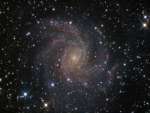 Facing NGC 6946
15.08.2008
From our vantage point in the Milky Way Galaxy, we see NGC 6946 face-on. The big, beautiful spiral galaxy is located just 10 million light-years away, behind a veil of foreground dust and stars in the high and far-off constellation of Cepheus.
 Kepler s House in Linz
15.05.2018
Four hundred years ago today (May 15, 1618) Johannes Kepler discovered the simple mathematical rule governing the orbits of the solar system's planets, now recognized as Kepler's Third Law of planetary motion.
 Moon Pi and Mountain Shadow
14.03.2024
What phase of the Moon is 3.14 radians from the Sun? The Full Moon, of course. Even though the Moon might look full for several days, the Moon is truly at its full phase when it is Pi radians (aka 180 degrees) from the Sun in ecliptic longitude.
 Moon Pi and Mountain Shadow
14.03.2025
What phase of the Moon is 3.14 radians from the Sun? The Full Moon, of course. Even though the Moon might look full for several days, the Moon is truly at its full phase when it is Pi radians (aka 180 degrees) from the Sun in ecliptic longitude.
 Vega and Comet 12P Pons-Brooks
8.12.2023
On December 4, periodic Comet 12P/Pons-Brooks shared this telescopic field of view with Vega, alpha star of the northern constellation Lyra. Fifth brightest star in planet Earth's night, Vega is some 25 light-years distant while the much fainter comet was about 21 light-minutes away.
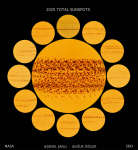 APOD: 2026 February 11 Б A Year of Sunspots
11.02.2026
How many sunspots can you see? The central image shows the many sunspots that occurred in 2025, month by month around the circle, and all together in the grand central image. Each sunspot is magnetically cooled and so appears dark -- and can last from days to months.
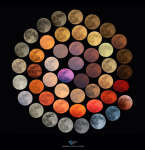 Colors of the Moon
11.11.2020
What color is the Moon? It depends on the night. Outside of the Earth's atmosphere, the dark Moon, which shines by reflected sunlight, appears a magnificently brown-tinged gray. Viewed from inside the Earth's atmosphere, though, the moon can appear quite different.
|
January February March April May June July August September October |
|||||||||||||||||||||||||||||||||||||||||||||||||