
|
You entered: eclipse
 Happy Birthday Charles Messier: M1
26.06.1996
French astronomer Charles Messier was born on June 26, 1730. Inspired by childhood sightings of comets and a solar eclipse visible from his home town of Badonvillier, he became an astronomer and comet hunter who kept careful records of his observations.
 The Belt of Venus Over Mercedes Argentina
7.02.2012
Although you've surely seen it, you might not have noticed it. During a cloudless twilight, just before sunrise or after sunset, part of the atmosphere above the horizon appears slightly off-color, slightly pink or orange.
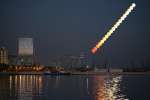 Baku Moonrise
8.12.2012
A Full Moon rises in this waterfront scene. Its colorful, watery reflection is joined by harbor lights and a windowed skyscraper's echo of the western horizon just after sunset. The tantalizing image is a composite of frames recorded at 2 minute intervals on November 28 from the Caspian Sea port city of Baku, Azerbaijan.
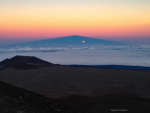 Full Moon in Mountain Shadow
21.10.2016
On October 15, standing near the summit of Hawaii's Mauna Kea and looking away from a gorgeous sunset produced this magnificent snapshot of a Full Moon rising within the volcanic mountain's shadow. An alignment across the Solar System is captured in the stunning scene and seeming contradiction of bright Moon in dark shadow.
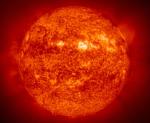 Helios Helium
20.01.2001
This image of the active Sun was made using ultraviolet light emitted by ionized Helium atoms in the Solar chromosphere. Helium was first discovered in the Sun in 1868, its name fittingly derived from from the Greek word Helios, meaning Sun. Credit for the discovery goes to astronomer Joseph Norman Lockyer (born May 17, 1836).
 AR 2192: Giant on the Sun
24.10.2014
As you (safely!) watched the progress of yesterday's partial solar eclipse, you probably also spotted a giant sunspot group. Captured in this sharp telescopic image from October 22nd the complex AR 2192 is beautiful to see, a sprawling solar active region comparable in size to the diameter of Jupiter.
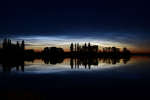 Noctilucent Clouds, Reflections, and Silhouettes
26.06.2019
Sometimes it's night on the ground but day in the air. As the Earth rotates to eclipse the Sun, sunset rises up from the ground. Therefore, at sunset on the ground, sunlight still shines on clouds above.
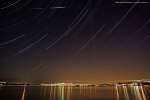 Perseid over Vancouver
16.08.2008
Colorful and bright, the city lights of Vancouver, Canada are reflected in the water in this portrait of the world at night. Recorded on August 12 during the Perseid Meteor Shower, the wide-angle view takes in a large swath along the photographer's eastern horizon.
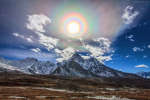 A Colorful Solar Corona over the Himalayas
11.01.2016
What are those colorful rings around the Sun? A corona visible only to Earth observers in the right place at the right time. Rings like this will sometimes appear when the Sun or Moon is seen through thin clouds.
 APOD: 2023 July 23 Б The Antikythera Mechanism
23.07.2023
It does what? No one knew that 2,000 years ago, the technology existed to build such a device. The Antikythera mechanism, pictured, is now widely regarded as the first computer. Found...
|
January February March April May June July August September October |
|||||||||||||||||||||||||||||||||||||||||||||||||