
|
You entered: eclipse
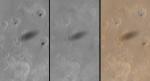 The Shadow of Phobos
17.09.2005
(xxxedit and linkxxx) Hurtling through space above the Red Planet, potato-shaped Phobos completes an orbit of Mars in less than eight hours. In fact, since its orbital period is shorter than the planet...
 M16: Inside the Eagle Nebula
28.12.2020
From afar, the whole thing looks like an Eagle. A closer look at the Eagle Nebula, however, shows the bright region is actually a window into the center of a larger dark shell of dust. Through this window, a brightly-lit workshop appears where a whole open cluster of stars is being formed.
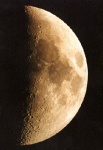 The Moon and All the Crashes
19.09.1996
A clear blue summer sky finally grows dark and the new telescope, hastily set up in the backyard, generates excitment and anticipation. "I bought it for the kids ...", Dad assures himself as he over-anxiously supervises the two young boys' efforts to center a bright, first quarter Moon, in the finder.
 APOD: 2024 April 15 Б The Cigar Galaxy from Hubble and Webb
15.04.2024
Something strange happened to this galaxy, but what? Known as the Cigar Galaxy and cataloged as M82, red glowing gas and dust are being cast out from the center. Although this starburst galaxy...
 APOD: 2024 April 16 Б Filaments of the Vela Supernova Remnant
16.04.2024
The explosion is over, but the consequences continue. About eleven thousand years ago, a star in the constellation of Vela could be seen to explode, creating a strange point of light briefly visible to humans living near the beginning of recorded history.
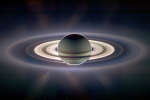 In the Shadow of Saturn
4.09.2011
In the shadow of Saturn, unexpected wonders appear. The robotic Cassini spacecraft now orbiting Saturn drifted in giant planet's shadow for about 12 hours in 2006 and looked back toward the eclipsed Sun. Cassini saw a view unlike any other.
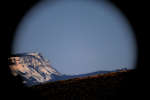 Spot the Moon
2.01.2012
Where's the full Moon? Somewhere in this image, the Earth's Moon is hiding. The entire Moon is visible, in its completely full phase, in plain sight. Even the photographer's keen...
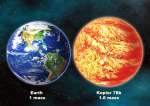 Kepler 78b: Earth Sized Planet Discovered
5.11.2013
Even though Kepler-78b is only slightly larger than the Earth, it should not exist. Its size is extraordinary only in the sense that it is the most similar in size to the Earth of any exoplanet yet directly discovered.
 ISS Double Transit
12.09.2015
Not once, but twice the International Space Station transits the Sun on consecutive orbits of planet Earth in this video frame composite. The scene was captured on August 22 from a single well-chosen location in Schmalenbeck, Germany where the ISS created intersecting shadow paths only around 7 kilometers wide.
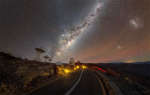 A Road to the Stars
15.03.2022
Pictured -- a very scenic road to the stars. The road approaches La Silla Observatory in Chile, with the ESO's 3.6-meter telescope just up ahead. To the left are some futuristic-looking support structures...
|
January February March April May June July August September October |
|||||||||||||||||||||||||||||||||||||||||||||||||