
|
You entered: eclipse
 The Dark Tower in Scorpius
21.08.2024
In silhouette against a crowded star field along the tail of the arachnological constellation Scorpius, this dusty cosmic cloud evokes for some the image of an ominous dark tower. In fact, monstrous clumps...
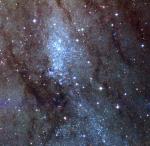 Stars of NGC 206
2.04.1999
Nestled within the dusty arms of the large spiral galaxy Andromeda (M31), the star cluster NGC 206 is one of the largest star forming regions known in our local group of galaxies. The beautiful...
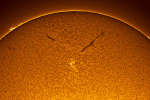 A Sunspot in the New Solar Cycle
5.02.2008
A new cycle has begun on our Sun. Over the past year, the Sun's magnetic field has reset and now a new 11 year period is beginning. Pictured above in a specific color of light emitted by hydrogen is sunspot 10982, one of the first sunspots of the new solar cycle.
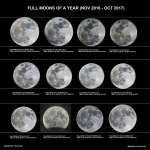 A Year of Full Moons
4.11.2017
Do all full moons look the same? No. To see the slight differences, consider this grid of twelve full moons. From upper left to lower right, the images represent every lunation from 2016 November through 2017 October, as imaged from Pakistan.
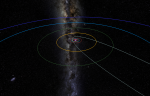 Animation: Perseid Meteor Shower
7.08.2018
Where do Perseid meteors come from? Mostly small bits of stony grit, Perseid meteoroids were once expelled from Comet Swift-Tuttle and continue to follow this comet's orbit as they slowly disperse. The featured animation depicts the entire meteoroid stream as it orbits our Sun.
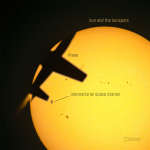 APOD: 2026 September 22 Б Chance Triple Alignment: Plane, Space Station, Sun
21.09.2026
This shot captured an unexpected silhouette. Which is it? It isn't the sunspots, the small dark regions caused by concentrated magnetic fields visible around the Sun's bright disk. Sunspots typically last for weeks and were expected, since these spots were seen previously.
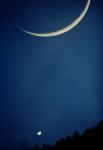 Moon And Venus Share The Sky
28.07.2000
July is drawing to a close and in the past few days, some early morning risers could have looked east and seen a crescent Moon sharing the pre-dawn skies with planets Jupiter and Saturn.
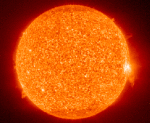 Helios Helium
16.05.1998
This image of the relatively quiet Sun was made using ultraviolet light emitted by ionized Helium atoms in the Solar chromosphere. Helium was first discovered in the Sun in 1868, its name fittingly derived from from the Greek word Helios, meaning Sun.
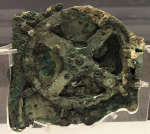 The Antikythera Mechanism
20.03.2021
No one knew that 2,000 years ago, the technology existed to build such a device. The Antikythera mechanism, pictured, is now widely regarded as the first computer. Found at the bottom...
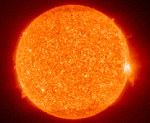 Helios Helium
20.05.1996
Above is an image of the relatively quiet Sun made on May 18 in light emitted by ionized Helium atoms in the Solar chromosphere. Helium was first discovered in the Sun in 1868, its name fittingly derived from from the Greek word Helios, meaning Sun. Credit for the discovery goes to astronomer Joseph Lockyer.
|
January February March April May June July August September October |
|||||||||||||||||||||||||||||||||||||||||||||||||