
|
You entered: Sun
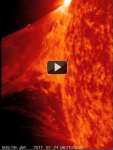 A Solar Prominence Eruption from SDO
7.03.2011
One of the most spectacular solar sights is an erupting prominence. Two weeks ago, NASA's Sun-orbiting Solar Dynamic Observatory spacecraft imaged an impressively large prominence erupting from the surface. The dramatic explosion...
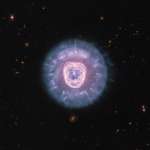 APOD: 2026 August 26 Б JWST Images The Lion's Head Nebula
26.08.2026
Are we looking at the future of our Sun? The James Webb Space Telescope captured todayБs composite image of the LionБs Head Nebula (NGC 2392) with its NIRCam and MIRI instruments. The LionБs Head Nebula is the remnant of a Sun-like star.
 APOD: 2026 September 20 Б Analemma over the Callanish Stones
20.09.2026
If you went outside at the same time every day and took a picture that included the Sun, how would the Sun's position change? A visual answer to that question is an analemma, a composite image taken from the same spot at the same time over the course of a year.
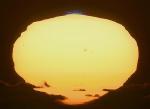 Blue Flash
9.01.2002
Difficult to observe, the momentary green flash above the rising or setting sun has been documented as a phenomenon caused by the atmospheric bending or refraction of sunlight. Like a weak prism, the Earth's atmosphere breaks white sunlight into colors, bending red colors slightly and green and blue colors through increasingly larger angles.
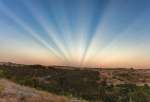 Anticrepuscular Rays over Sicily
25.06.2026
The Sun has just set... in the opposite side of the sky. Pictured here are anticrepuscular rays apparently converging in the east in this image of the limestone plateau in the heart of the Hyblaean Mountains of southeastern Sicily, in Italy. How were these anticrepuscular rays formed, if the Sun wasn't there?
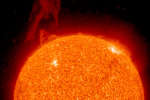 A Solar Prominence Erupts in STEREO
20.10.2009
What does a solar prominence look like in three dimensions? To help find out, NASA launched the STEREO satellites to keep a steady eye on the Sun from two different vantage points. The STEREO...
 APOD: 2023 December 11 Б Solar Minimum versus Solar Maximum
11.12.2023
The surface of our Sun is constantly changing. Some years it is quiet, showing relatively few sunspots and active regions. Other years it is churning, showing many sunspots and throwing frequent Coronal Mass Ejections (CMEs) and flares.
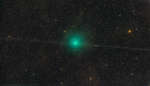 APOD: 2026 July 17 Б The Dust Trail of Comet Tempel 2
17.07.2026
Comet 10P/Tempel 2 orbits the Sun once every 5.4 years. Currently visible in binoculars or small telescopes toward the constellation Capricornus, the periodic comet is captured in this sharp telescopic image from July 11 sporting a bright nuclear region and pretty greenish coma.
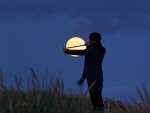 Moon Games
1.08.2008
The Moon's measured diameter is around 3,476 kilometers (2,160 miles). But apparent angular size, or the angle covered by an object, can also be important to Moon enthusiasts. Angular size depends on distance, the farther away an object is, the smaller an angle it covers.
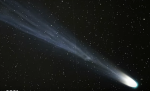 Video: Comet Leonard over One Hour
25.01.2022
Which direction is this comet heading? Judging by the tail, one might imagine that Comet Leonard is traveling towards the bottom right, but a full 3D analysis shows it traveling almost directly away from the camera.
|
January February March April May June July August September |
|||||||||||||||||||||||||||||||||||||||||||||||||