
|
You entered: Sun
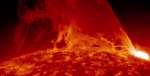 A Solar Prominence Eruption from SDO
6.03.2016
One of the most spectacular solar sights is an erupting prominence. In 2011, NASA's Sun-orbiting Solar Dynamic Observatory spacecraft imaged an impressively large prominence erupting from the surface. The dramatic explosion was captured in ultraviolet light in the above time lapse video covering 90 minutes, where a new frame was taken every 24 seconds.
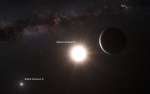 A View from Next Door
18.10.2012
Located just next door, Alpha Centauri is the closest star system to the Sun. A view from our interstellar neighbor a mere 4.3 light-years away is shown in this illustration. The Sun is at the upper right, a bright star against the background of the Milky Way.
 APOD: 2023 March 28 Б A Multiple Green Flash Sunset
28.03.2023
Yes, but can your green flash do this? A green flash at sunset is a rare event that many Sun watchers pride themselvesбon having seen.б Once thought to be a myth, a green flash is now understood to occur when the Earth's atmosphere acts like both a prism and a lens.
 APOD: 2023 October 15 Б An Eclipse Tree
15.10.2023
Yes, but can your tree do this? If you look closely at the ground in the featured image, you will see many images of yesterday's solar eclipse -- created by a tree. Gaps between...
 APOD: 2024 October 15 Б Animation: Comet Tsuchinshan ATLAS Tails Prediction
15.10.2024
How bright and strange will the tails of Comet Tsuchinshan-ATLAS become? The comet has brightened dramatically over the few weeks as it passed its closest to the Sun and, just three days ago, passed its closest to the Earth.
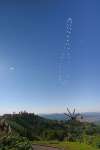 Austrian Analemma
22.09.2012
Today, the Sun crosses the celestial equator heading south at 14:49 Universal Time. An equinox (equal night), this astronomical event marks the first day of autumn in the northern hemisphere and spring in the south.
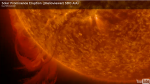 A Huge Solar Filament Erupts
15.12.2010
Click the arrow and watch an unusually long filament explode out from the Sun. The filament had been seen hovering over the Sun's surface for over a week before it erupted earlier this month.
 A Total Solar Eclipse Close Up in Real Time
12.09.2017
How would you feel if the Sun disappeared? Many eclipse watchers across the USA surprised themselves with the awe that they felt and the exclamations that they made as the Sun momentarily disappeared behind the Moon.
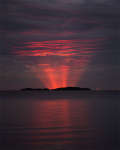 Red Crepuscular Rays from an Eclipse
30.05.2022
What's happening behind that island? Things both expected and unexpected. Expected, perhaps, the pictured rays of light -- called crepuscular rays -- originate from the Sun. Unexpected, though, the Sun was being partially eclipsed by the Moon at the time -- late last month.
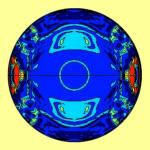 Solar Neutrino Astronomy
17.05.2001
Neutrinos are subatomic particles generated by the nuclear reactions which power stars like our Sun. Flying outward from the Sun's core, they easily pass through the Sun (and almost anything else!) unimpeded and should be detectable by earth-based neutrino "telescopes".
|
January February March April May June July August September |
|||||||||||||||||||||||||||||||||||||||||||||||||