
|
You entered: Sun
 Analemma 2010
31.12.2010
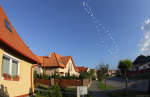
Looking back on the year, have you wondered where the Sun was in the sky each day during 2010 at exacty 9am UT? Of course you have. Search no further for the answer! It was somewhere along this celestial figure 8 curve known as an analemma.
 Violent Sunspot Group AR 1302 Unleashes a Flare
28.09.2011
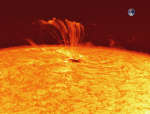
One of the most active sunspot groups in years is currently crossing the Sun. AR 1302 first came around the Sun's edge last week and is so large it can be seen without a telescope.
 Analemma over the Callanish Stones
18.09.2022
If you went outside at the same time every day and took a picture that included the Sun, how would the Sun's position change? A more visual answer to that question is an analemma, a composite image taken from the same spot at the same time over the course of a year.
 Comet Hyakutake's Orbit
14.03.1996
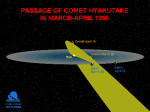
Where did Comet Hyakutake come from? The orbits of the Earth and this brightening comet are shown in the above diagram. The blue disk is bounded by the circular orbit of the Earth about the central Sun. The comet's path outlines the green shape.
 Diamond Ring in a Cloudy Sky
25.08.2017
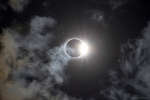
As the Moon's shadow swept across the US on August 21, eclipse chasers in the narrow path of totality were treated to a diamond ring in the sky. At the beginning and end of totality, the fleeting and beautiful effect often produces audible gasps from an amazed audience.
 The Case of the Backwards Orbiting Asteroid
30.05.2018
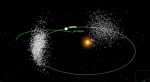
Why does asteroid 2015 BZ509 orbit the Sun the backwards? As shown in the featured animation, Jupiter's trojan asteroids orbit the Sun in two major groups -- one just ahead of Jupiter, and one just behind -- but all orbit the Sun in the same direction as Jupiter.
 Venus Transit at Sunrise
9.06.2004
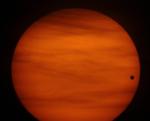
Did you see the transit? While some watched by webcast, sky gazers in Europe, the Middle East, Africa, and Asia were able to witness the complete 6 hour journey of Venus' silhouetted disk across the face of the Sun.
 Mercury and the Chromosphere
10.11.2006
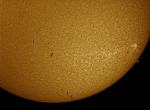
Enjoying Wednesday's transit of Mercury from Dallas, Texas, astronomer Phil Jones recorded this detailed image of the Sun. Along with a silhouette of the innermost planet, a network of cells and dark filaments can be seen against a bright solar disk with spicules and prominences along the Sun's edge.
 Follow The Spots
21.10.1999
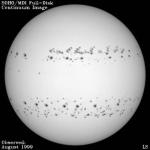
The Sun rotates on its axis about once every 27 days. How can you tell? Just follow the sunspots. This composite picture was constructed from solar images recorded daily by the MDI instrument on board the space-based SOlar and Heliospheric Observatory (SOHO).
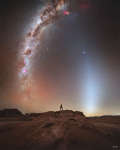 APOD: 2026 July 6 Б Dueling Bands over the Atacama Desert
6.07.2026
What are these two bands in the sky? The more commonly seen band is on the left and is the central band of our Milky Way galaxy. Our Sun orbits in the disk of this spiral galaxy so that from inside, it appears as a band of comparable brightness all the way around the sky.
|
January February March April May June July August September |
|||||||||||||||||||||||||||||||||||||||||||||||||