
|
You entered: Sun
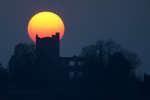 Sunspot Castle
12.11.2011
Each day can have a beautiful ending as the Sun sets below the western horizon. This week, the setting Sun added naked-eye sunspots to its finale, as enormous active regions rotated across the dimmed, reddened solar disc.
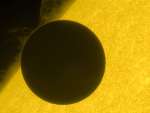 Venus at the Edge
9.06.2012
As its June 6 2012 transit begins Earth's sister planet crosses the edge of the Sun in this stunning view from the Hinode spacecraft. The timing of limb crossings during the rare transits was used historically to triangulate the distance to Venus and determine a value for the Earth-Sun distance called the astronomical unit.
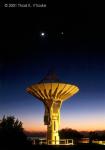 Bright Venus
8.03.2001
Have you seen a bright evening star in the western sky lately? That's no star, that's planet Venus the second "rock" from the Sun. Blazing at -4.6 magnitude, Venus, after the Sun and Moon, is the third brightest celestial body in planet Earth's sky.
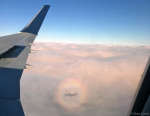 An Airplane Glory
22.12.2016
Looking out the window of an airplane, you might be lucky enough to see "the glory" in the direction directly opposite the Sun. Before airplanes, the phenomenon, known to some as the heiligenschein or the Specter of the Brocken, was sometimes seen from mountaintops.
 APOD: 2024 February 28 Б Shades of Night
28.02.2024
How does the sky turn dark at night? In stages, and with different characteristic colors rising from the horizon. The featured image shows, left to right, increasingly late twilight times after sunset in 20 different vertical bands. The picture was taken last month in Syracuse, Sicily, Italy, in the direction opposite the Sun.
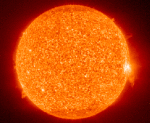 Helios Helium
20.05.1996
Above is an image of the relatively quiet Sun made on May 18 in light emitted by ionized Helium atoms in the Solar chromosphere. Helium was first discovered in the Sun in 1868, its name fittingly derived from from the Greek word Helios, meaning Sun. Credit for the discovery goes to astronomer Joseph Lockyer.
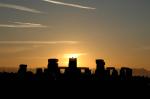 Sunrise Solstice at Stonehenge
21.06.2006
Today the Sun reaches its northernmost point in the planet Earth's sky. Called a solstice, the date traditionally marks a change of seasons -- from spring to summer in Earth's Northern Hemisphere and from fall to winter in Earth's Southern Hemisphere. Pictured above is the 2005 Summer Solstice celebration at Stonehenge in England.
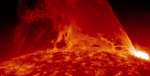 A Solar Prominence Eruption from SDO
26.05.2019
One of the most spectacular solar sights is an erupting prominence. In 2011, NASA's Sun-orbiting Solar Dynamic Observatory spacecraft imaged an impressively large prominence erupting from the surface. The dramatic explosion was captured in ultraviolet light in the featured time lapse video covering 90 minutes, where a new frame was taken every 24 seconds.
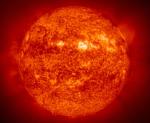 Helios Helium
20.01.2001
This image of the active Sun was made using ultraviolet light emitted by ionized Helium atoms in the Solar chromosphere. Helium was first discovered in the Sun in 1868, its name fittingly derived from from the Greek word Helios, meaning Sun. Credit for the discovery goes to astronomer Joseph Norman Lockyer (born May 17, 1836).
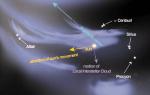 The Local Interstellar Cloud
10.02.2002
The stars are not alone. In the disk of our Milky Way Galaxy about 10 percent of visible matter is in the form of gas, called the interstellar medium (ISM). The ISM is not uniform, and shows patchiness even near our Sun.
|
January February March April May June July August September |
|||||||||||||||||||||||||||||||||||||||||||||||||