
|
You entered: Earth
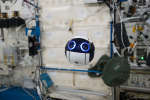 Int Ball Drone Activated on the Space Station
25.07.2017
What if you were followed around by a cute floating ball that kept taking your picture? Then you might be an astronaut on today's International Space Station (ISS). Designed by the Japan Aerospace...
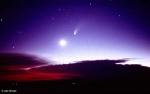 Hale-Bopp: The Crowd Pleaser Comet
9.07.1998
In 1997, the bright comet Hale-Bopp may have become the most viewed comet in history -- visible even to casual skywatchers in light polluted cities around the globe. In this picture, taken by photographer...
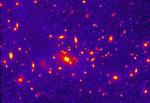 A Massive Cluster In A Young Universe
21.08.1998
Conventional theories suggest that this cluster of galaxies should not exist. Each fuzzy spot in this false-color Hubble Space Telescope image of the central regions of a newly discovered galaxy cluster is a galaxy similar in mass to our own Milky Way.
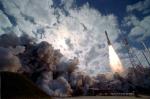 New Horizons Launches to Pluto
24.01.2006
Destination: Pluto. The New Horizons spacecraft roared off its launch pad at Cape Canaveral in Florida, USA last week toward adventures in the distant Solar System. The craft is one of the fastest spaceships...
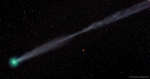 A Split Ion Tail for Comet Lovejoy E4
25.04.2017
What's happened to Comet Lovejoy? In the pictured image, a processed composite, the comet was captured early this month after brightening unexpectedly and sporting a long and intricate ion tail. Remarkably, the typically...
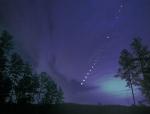 Eclipsed Moonlight from Connelly s Springs
11.11.2003
Happily, skies over Connelly's Springs, North Carolina, USA were not mostly cloudy, as forecast, on the evening of November 8. In fact they were mostly clear early on, allowing photographer David Cortner to record the evening's scheduled celestial entertainment, a total lunar eclipse.
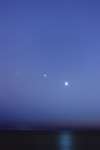 Conjunctions near Dawn
30.06.2012
Now shining in eastern skies at dawn, bright planets Venus and Jupiter join the Pleiades star cluster in this sea and sky scape, recorded earlier this week near Buenos Aires, Argentina. Venus dominates the scene that includes bright star Aldebaran just below and to the right.
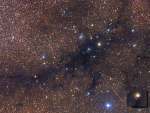 LDN 988: Dark Nebula in Cygnus
19.11.2014
Obscuring the rich starfields of northern Cygnus, dark nebula LDN 988 lies near the center of this cosmic skyscape. Composed with telescope and camera, the scene is some 2 degrees across. That corresponds to 70 light-years at the estimated 2,000 light-year distance of LDN 988.
 October Skylights
8.11.2000
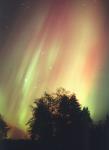
With brilliant Venus above the western horizon at sunset and Jupiter and Saturn high in the east by early evening, November's night sky is filled with bright planets. October's sky featured bright planets as well and, triggered by the active Sun, some lovely auroral displays.
 NEAR to Asteroid Eros
28.12.1998
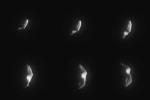
On December 23, the NEAR spacecraft flew by asteroid 433 Eros. NEAR was originally scheduled to brake and orbit Eros, but an unexpected shutdown of its main engine caused this plan to be aborted. NEAR will now be reset and attempt to return to orbit Eros in early 2000.
|
January February March April May June July August September October |
|||||||||||||||||||||||||||||||||||||||||||||||||