
|
You entered: Earth
 Beta Pictoris Revisited
28.11.1997
In the early 1980s, Beta Pictoris became one of the most important stars in the sky. Satellite and ground-based telescopic observations revealed the presence of a surrounding outer disk of material and an inner "clear" zone about the size of our solar system - strong evidence for the formation of planets.
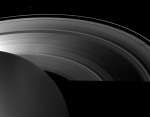 Shadows of Saturn at Equinox
1.09.2009
Unusual shadows and dark rings appeared around Saturn near its equinox last month. At that time -- early August -- Saturn's ring plane pointed directly at the Sun. Visible above, Saturn's moon Tethys casts a shadow visible only on the far right.
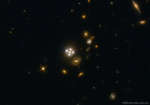 Four Quasar Images Surround a Galaxy Lens
27.02.2017
An odd thing about the group of lights near the center is that four of them are the same distant quasar. This is because the foreground galaxy -- in the center of the quasar images and the featured image -- is acting like a choppy gravitational lens.
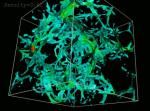 The Lyman Alpha Forest
12.11.2000
We live in a forest. Strewn throughout the universe are "trees" of hydrogen gas that absorb light from distant objects. These gas clouds leave numerous absorption lines in a distant quasar's spectra, together called the Lyman-alpha forest.
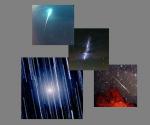 Leonid Watching
16.11.2001
Will the Leonids storm this year? The annual Leonid meteor shower should peak this weekend and some predictions suggest that "storm" rates of a thousand or more meteors per hour are possible for observers located in eastern North and Central America during the early morning hours of Sunday, November 18.
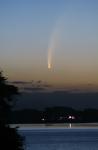 Southern Comet
18.01.2007
After a remarkable performance in the northern hemisphere, the brightest comet in decades is now showing off in the south. Recorded during evening twilight on January 17, this view features the bright coma...
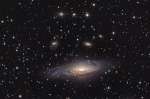 NGC 7331 and Beyond
24.10.2009
Big, beautiful spiral galaxy NGC 7331 is often touted as an analog to our own Milky Way. About 50 million light-years distant in the northern constellation Pegasus, NGC 7331 was recognized early on as a spiral nebula and is actually one of the brighter galaxies not included in Charles Messier's famous 18th century catalog.
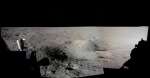 Apollo 11 Landing Site Panorama
19.12.2014
Have you seen a panorama from another world lately? Assembled from high-resolution scans of the original film frames, this one sweeps across the magnificent desolation of the Apollo 11 landing site on the Moon's Sea of Tranquility.
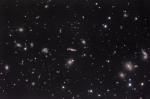 The Hercules Cluster of Galaxies
27.04.2005
These are galaxies of the Hercules Cluster, an archipelago of "island universes" a mere 650 million light-years distant. This cluster is loaded with gas and dust rich, star forming, spiral galaxies but has relatively few elliptical galaxies, which lack gas and dust and the associated newborn stars.
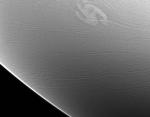 Saturn Storm by Ringshine
23.02.2006
Imaged on the night side of Saturn by the Cassini spacecraft, these swirling storm clouds are illuminated by ringshine - sunlight reflected from the gas giant's magnificent ring system. The storm (top) was actually spotted last month by amateur astronomers as it rotated across Saturn's day side and spans about 3,500 kilometers.
|
January February March April May June July August September October |
|||||||||||||||||||||||||||||||||||||||||||||||||