
|
You entered: Earth
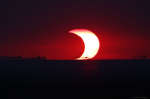 A Partial Eclipse Over Manila Bay
11.02.2018
What's happened to the setting Sun? An eclipse! In early 2009, the Moon eclipsed part of the Sun as visible from parts of Africa, Australia, and Asia. In particular the featured image, taken from the Mall of Asia seawall, caught a partially eclipsed Sun setting over Manila Bay in the Philippines.
 APOD: 2023 August 21 Б Introducing Comet Nishimura
21.08.2023
Will Comet Nishimura become visible to the unaided eye? Given the unpredictability of comets, no one can say for sure, but it currently seems like a good bet. The comet was discovered only ten days ago by Hideo Nishimura during 30-second exposures with a standard digital camera.
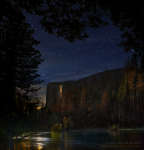 Firefall by Moonlight
8.06.2017
On certain dates in February, an elusive firefall can be spotted at sunset in Yosemite National Park, when the weather cooperates and the direction to the setting Sun is just right. Often photographed from...
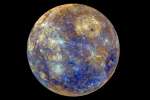 Colors of Mercury
1.03.2013
The colors of the solar system's innermost planet are enhanced in this tantalizing view, based on global image data from the Mercury-orbiting MESSENGER spacecraft. Human eyes would not discern the clear color differences but they are real none the less, indicating distinct chemical, mineralogical, and physical regions across the cratered surface.
 APOD: 2025 November 25 Б Comet Lemmon and the Milky Way
25.11.2025
What did Comet Lemmon look like when it was at its best? One example is pictured here, featuring three celestial spectacles all at different distances. The closest spectacle is the snowcapped Meili Mountains, part of the Himalayas in China.
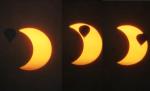 Sun, Moon, Hot Air Balloon
6.06.2003
Anticipating the celestial shadow play of a solar eclipse, sky gazers across Germany watched the Sun rise on May 31. In Bonn, astrophotographer Thilo Kranz had set up his small refractor telescope and camera on the Kennedy Bridge across the Rhein river to get a good view to the northeast.
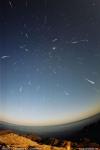 Leonids and Leica
18.11.2006
This lovely view from northern Spain at Cape Creus on the easternmost point of the Iberian peninsula, looks out across the Mediteranean and up into the stream of the 2002 Leonid meteor shower. The picture is a composite of thirty separate one minute exposures taken through a fisheye lens.
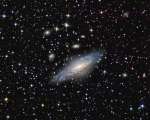 NGC 7331 and Beyond
12.07.2008
Big, beautiful spiral galaxy NGC 7331 is often touted as an analog to our own Milky Way. About 50 million light-years distant in the northern constellation Pegasus, NGC 7331 was recognized early on as a spiral nebula and is actually one of the brighter galaxies not included in Charles Messier's famous 18th century catalog.
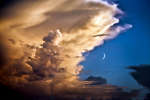 Clouds, Birds, Moon, Venus
4.03.2018
Sometimes the sky above can become quite a show. In early September of 2010, for example, the Moon and Venus converged, creating quite a sight by itself for sky enthusiasts around the globe. From some locations, though, the sky was even more picturesque.
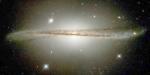 Warped Spiral Galaxy ESO 510 13
3.08.2001
How did spiral galaxy ESO 510-13 get bent out of shape? The disks of many spirals are thin and flat, but not solid. Spiral disks are loose conglomerations of billions of stars and diffuse gas all gravitationally orbiting a galaxy center.
|
January February March April May June July August September October |
|||||||||||||||||||||||||||||||||||||||||||||||||