
|
You entered: Earth
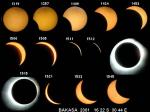 Bakasa Eclipse Sequence
6.07.2001
Starting at the upper left, this sequence of images follows the progress of the magnificent 21 June, 2001 solar eclipse in the clear skies over Bakasa, Zimbabwe. These pictures were recorded using a small reflecting telescope and digital camera with the approximate local time given above each frame.
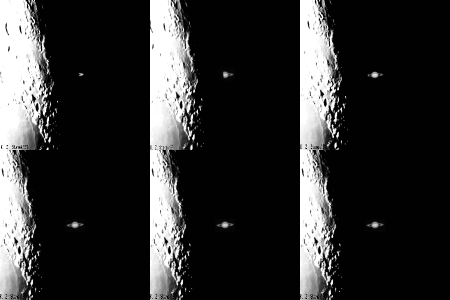 Moon Occults Saturn
8.09.2001
On September 18, 1997, many stargazers in the U. S. were able to watch a lovely early morning lunar occultation as a bright Moon passed in front of Saturn. Using a 1.2 meter reflector, astronomer Kris Stanek had an excellent view of this dream-like event from the Whipple Observatory atop Arizona's Mount Hopkins.
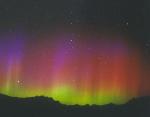 Meteors and Northern Lights
15.08.2002
Skygazers report that the annual Perseid meteor shower went pretty much as predicted, producing a meteor every few minutes during the dark early morning hours of August 12 and 13. And as the constellation...
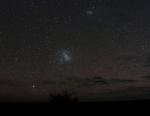 Magellanic Morning
9.08.2006
This early morning skyscape recorded near Winton, Queensland, Australia, looks toward the southeast. Low clouds are seen in silhouette against the first hints of sunlight, while two famous cosmic clouds, the Clouds of Magellan, also hover in the brightening sky.
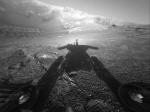 Shadow of a Martian Robot
4.02.2007
What if you saw your shadow on Mars and it wasn't human? Then you might be the Opportunity rover currently exploring Mars. Opportunity and sister robot Spirit have been probing the red planet since early 2004, finding evidence of ancient water, and sending breathtaking images across the inner Solar System.
 Venus and the Pleiades in April
11.04.2020
Shared around world in early April skies Venus, our brilliant evening star, wandered across the face of the lovely Pleiades star cluster. This timelapse image follows the path of the inner planet during the beautiful conjunction showing its daily approach to the stars of the Seven Sisters.
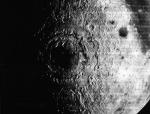 Mare Orientale
23.11.2002
Like a target ring bull's-eye, the Mare Orientale is one of the most striking large scale lunar features. Located on the Moon's extreme western edge, this impact basin is unfortunately difficult to see from an earthbound perspective.
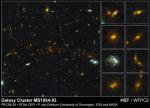 Cosmic Collisions in a Galaxy Cluster
22.07.1999
Hundreds of galaxies appear as faint smudges of light in this Hubble Space Telescope picture of galaxy cluster MS1054-03. Eight billion light-years away, the cluster is among the most distant known clusters of galaxies and is now reported to contain the largest number of colliding galaxies ever found in a cluster.
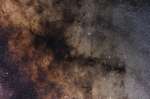 East of Antares
22.05.2009
East of Antares, dark markings sprawl through crowded star fields toward the center of our Milky Way Galaxy. Cataloged in the early 20th century by astronomer E. E. Barnard, the obscuring interstellar dust clouds include B59, B72, B77 and B78, seen in silhouette against the starry background.
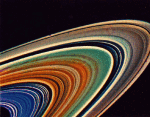 The Rings of Saturn
30.07.1995
Saturn's spectacular system of bright rings has been the subject of study and wonder since Galileo first turned his telescope on the ringed planet in 1610. To Galileo, the blurry image produced by his small telescope was confusing. Saturn appeared to him to have "ear-like" appendages which he thought might be large moons.
|
January February March April May June July August September October |
|||||||||||||||||||||||||||||||||||||||||||||||||